


This one’s been a long time coming!
We video recorded this entire tasting but unfortunately lost the footage in a hard-drive fatality. Thankfully, we took copious notes and recorded our scores on paper so delivering this tasting as a written post was still something we could do. And here it is, just in time for your Dry January needs.
We are fascinated by de-alcoholized wines. We love the innovations, the passion of the winemakers, at least the ones we’re going to feature here this month. We love that its a category that supports vineyards and grape sales and adds to the existing wine market. And we’re not gonna lie: performing this tasting and even finishing off the bottles afterwards without really needing to worry about alcohol and in some cases calorie counts…that was pretty nice.
And let’s get this out of the way before we begin: we’d love to hear your thoughts in the comments, however…we’re not interested in debating whether de-alc wine is wine or not. It is. No argument against it being so holds any logical water. It’s made like every other wine, with grapes, usually Vitis vinifera wine grapes, and undergoes fermention. The nitty gritty beyond those facts is winemaking practices and please do believe and tell yourself whatever you like in regards to those. But we’re not going to engage with the fundamental, baseline question here, beause we don’t believe it’s a question.
That said, there are still plenty of things up for debate in regards to de-alc wine, and for our purposes here, we wanted to weigh in on how far the category has come (or not come) by the tail end of 2025/beginning of 2026. And to determine this to the best of our ability, we set up some ground rules…
The Rules
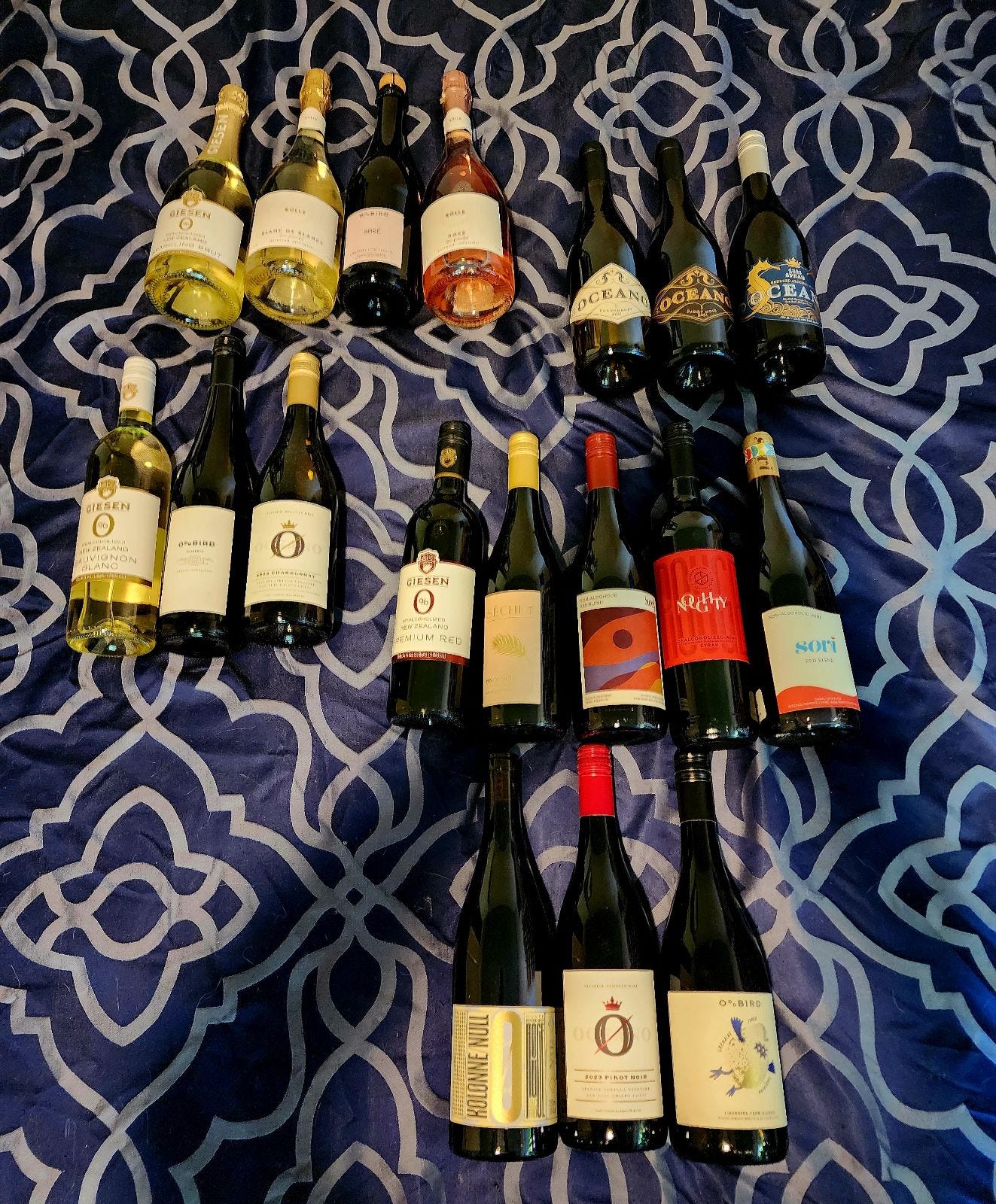
We only tasted wines that were marketed (and/or priced) as “Premium” and “Ultra-Premium”, because we wanted to put the best of the best to the test, made by winemakers who are passionate about the category and not bulk brands cashing in on a trend. Just as we typically do regarding any other category of wine. Naturaly, we only targeted brands readily available to us in Los Angeles, CA.
We only tasted de-alcoholized wines, so liquid that was made as actual, traditional wine before having the alcohol removed. We avoided anything labeled as a “Non-Alcoholic Wine Alternatives” which are literally not wine, but rather tea-based and other such beverages that are naturally alcohol free.
All wines used “spinning cone” vacuum distillation. which is currently the best technology for removing alcohol while preserving aromas and flavors.
We did not judge these wines based on how closely they mimicked full-alcohol wines. Because why would they? Nothing should mimic something they are not, any more than a red wine (with skin contact) should mimic a white (skins removed.) Instead, we judged these wines based on their own merits of deliciousness and satisfaction when the alcohol is removed.
We kept the scoring system simple: 1-5 points for each of four categories: Aroma/Taste, Complexity, Balance, and Body.
While we tasted through sparkling, whites, and roses, we focused on reds, as these are the hardest to pull off.
We tasted each category starting with the least sugar to the most, so as to not let sugary sweetness muddy the perception of a less sweet follow-up.
In order to calibrate our palates to the “body” that should be expected of non-alcoholic liquid with tannins and/or moderate levels of sugar, we sipped and took note of the textures of a lightly sweetened black tea (to mimic the still wines) and a lightly sweetened soda (to mimic the sparkling,) both of which had sugar levels that roughly matched the average sugar of the wines. This doubled nicely as a test for how much better - or not - the de-alc wines were to these common non-wine alternatives.
We tasted:
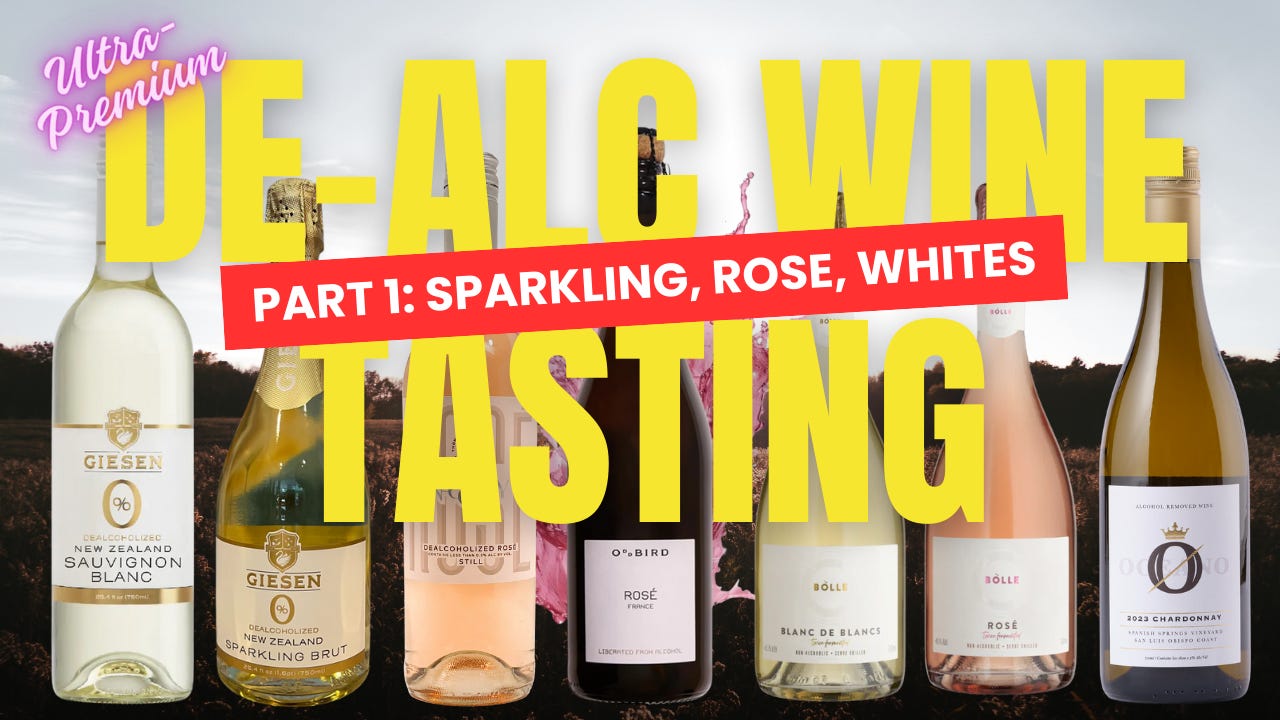
2 Sparkling Whites (Part 1)
2 Sparkling Roses (Part 1)
3 Still Whites (Part 1)
1 Still Rose (Part 1)
8 Still Reds! (Part 2)
Plus one low-acl (3.5% ABV) and 2 Full Alc wines, as one winery made both fully de-alc and full-alc versions of the same 2 wines, so we tasted these side-by-side. (Parts 1 and 2)
Got all that? Then let’s begin…
The Sparkling Wines
Sparkling Whites
1) Giesen Sparkling Brut Zero, New Zealand $19.99
98% Dealcoholized wine, 2% grape juice
Predominantly Sauvignon Blanc
3g sugar per 5oz serving / 15g sugar per bottle
20cal per 5oz serving / 100cal per bottle
Weirdly great source of Potassium! 20% Daily Value per bottle!


From the winery: Using innovative spinning cone technology popular in perfume-making, we separate our full-strength wine into three parts: aroma, alcohol, and body. We leave the alcohol behind, recombining the body of wine with that delectable aroma to craft a premium dealcoholized wine with all the characteristics you enjoy from its full-strength counterparts. We then add just a touch of premium grape juice to round out the final blend.
TASTING NOTES: The most “budget” of the wines we tasted, this retails for $19.99 / bottle. While sporting very little sugar compared to other sparklers, this nevertheless tasted the most sweet and grape juice-y. The bubbles and a certain acidity keep this from feeling heavy up front but then a somewhat cloying mouthfeel remains on the finish. Sugary enough to leave stickiness on the fingers, the whole experience was a bit too “juice”-like, and a mere two-notes - juicy, effervescent, and little else. Pleasant, we’d happily drink this wherever it was being poured, but unlikely to seek it out.
DAVE: 10/20
Aroma/Taste - 2.5
Complexity - 2.5
Balance - 2.5
Body - 2.5
DALLAS: 8 / 20
Aroma/Taste - 2
Complexity - 2
Balance - 2
Body - 2
2) Bolle Blanc de Blanc NV, La Mancha, Spain $39.99
22.5cal per 5oz serving / 112.5cal per bottle
4.2g sugars per serving / 21g sugar per bottle
Chardonnay from La Mancha, Spain
Undergoes a secondary fermentation in tank!


From the winery: BOLLE (“Bubbles” - from “Prendi una bottiglia di bolle”, ”Bring a bottle of bubbles”) consists of Chardonnay wine that is gently de-alcoholised through state of the art vacuum distillation. We then add additional grape juice and yeast, and return to the tank for a secondary fermentation. Once fermented, we add some CO2 to increase the fizz (most is created naturally in the tank) and a little preservative to help prevent oxidisation and bacterial spoilage. Pure wine, no added sugars, flavours, or colours.
Note on that “secondary fermentation”: We were confused by this, too! But we dug up an interview with the founder where he explained: they use a special strain of yeast that adds additional flavors, aromas, and bubbles…but creates minimal alcohol! So minimal the total remains below the 0.5% threshold for being labeled “non-alcoholic”.
TASTING NOTES: Wow. This sparkling wine was impressive. Fizzy in just the right way, perfect texture, crisp, fruity, noticeable minerality, gentle bready notes. And even though this contained more sugar than the Giesen, it did not taste like it. Everything here is in near-perfect balance, though the complexity could be deeper. This secondary fermentation technique with non-aclohol producing yeasts is plainly one to watch. Drinks like a very good Cava but at the higher cost of an “affordable” Champagne ($40).
DAVE: 16/20
Aroma/Taste - 4
Complexity - 3.5
Balance - 4.5
Body - 4
DALLAS: 14/20
Aroma/Taste - 4
Complexity - 3
Balance - 3
Body - 4
Sparkling Roses
1) Bolle Sparkling Rose NV, La Mancha, Spain - $39.99
22.5cal per 5oz serving / 112.5cal per bottle
4.5g sugars per serving / 22.5g sugar per bottle
75% Chardonnay, 25% Pinot Noir from La Mancha, Spain
Undergoes same secondary fermentation in tank. Vegan.


From the winery: (see Bolle Blanc de Blanc above)
Note from Dave: Although the nutrition label claims the exact same calories as the Blanc de Blanc, the sugar content went up slightly - from 21 to 22.5g per bottle. That should technically add 5-8 additional calories!
TASTING NOTES: This one didn’t sing to us like the Bolle Blanc de Blanc did. A bit too sweet and a bit too bitter in equal measures, however contradictory that sounds. Not horrifically so, but coming off the Blanc de Blanc, the lack of similar balance stood out. Textures in terms of the carbonation/”mousse” was still excellent, but the mouthfeel felt off a bit, too . Basically, the techniques used here are the same, so the texture/body was comparable, but the Pinot added too much bitterness, which a slightly elevated sugar level was not able to successfully counter.
DAVE: 12/20
Aroma/Taste - 3
Complexity - 3
Balance - 3
Body - 3
DALLAS: 8/20
Aroma/Taste - 2
Complexity - 2
Balance - 2
Body - 2
2) Oddbird Sparkling Rose NV, Languedoc-Rousillon, France - $25-$35
29cal per serving, 145cal per bottle
6g sugar per serving, 30g sugar per bottle
100% Organic Syrah from Provence
Vegan


From the winery: Silky, well-balanced and rather dry sparkling rosé from the Languedoc-Roussillon region of France. All-natural colour. The sparkling rosé is matured for 12 months before being gently liberated from alcohol by our patented process, which is quite complex but the easiest way to explain it is that we put the wine in a vacuum at room temperature and add a few degrees of heat and let the alcohol naturally evaporate.
Note from Dave: Sounds like vacuum distillation to me! Oddbird was one of the first to use it, though, starting over a decade ago.
TASTING NOTES: Color (pun intended!) us surprised - the sweetest and most sugar-laden of the sparkling wines by a good magin and it was fantastic. Oddbird has been working in the de-alc space longer than most, well before the trend, and their expertise shows. While noticably sweet, it was gorgeously so. There was real depth of flavor here, the fruit showcased front and center without tasting juice-y, the effervesence and acidity balanced with the sweetness and body. It fell just shy of the balance of the Bolle Blanc de Blanc, but absolutely trounces the Bolle Rose.
DAVE: 15.5/20
Aroma/Taste - 3.5
Complexity - 4
Balance - 4
Body - 4
DALLAS: 14/20
Aroma/Taste - 3.5
Complexity - 3.5
Balance - 3
Body - 4
Rose (Still)
Noughty Rose NV, Western Cape, South Africa - $25
98% Chenin Blanc / 2% Pinotage
25.2cal per serving / 126 per bottle
3.1g sugars per serving / 15.5g per bottle


From the winery: The grapes are harvested from dry-land farmed vineyards in the Western Cape region, where the vines are not trellised and are planted as bush vines. The vineyards are strategically planted on south-west facing slopes to capture cool breezes from the Atlantic Ocean and cold Benguela current. Deep soils from decomposed granite, clay rich, with good drainage. With 14 days fermentation at 14-15°C, the grapes and juice are handled reductively to prevent oxidation and lock in fruitiness. The wine is left on lees for 2 months to add complexity before being dealcoholized by way of a gently spun cone technology.
Note from Dave: “Spinning cone” is the same as vacuum distillation - it’s the specific version used for de-alcoholizing wine.
TASTING NOTES: We were on the same page with this one. It’s perfectly pleasant and inoffensive - fruity and smooth, balanced tartness and sweetness, no bitterness, nothing offputting. It’s a prime example of what George Nordahl would call “easy drinking”. It’s missing the more interesting, captivating aspects of wine, but it’s definitely well made and goes down easy. Balanced without being impressively so, as there isn’t too much being weighed. But ever-so-slightly above average on every front.
DAVE: 12/20
Aroma/Taste - 3
Complexity - 3
Balance - 3
Body - 3
DALLAS: 12/20
Aroma/Taste - 3
Complexity - 3
Balance - 3
Body - 3
Whites (Still)
1) Giesen Sauvignon Blanc Zero, New Zealand - $12-$15
80% Dealcoholized Sauvignon Blanc, 14% Dealcoholized White Wine (blend), 6% grape juice
2.6g sugar per 5oz serving / 13g sugar per bottle
20cal per 5oz serving / 100cal per bottle
Surprsingly good source of Potassium! 20% Daily Value per bottle!


From the winery: Using innovative spinning cone technology popular in perfume-making, we separate our full-strength wine into three parts: aroma, alcohol, and body. We leave the alcohol behind, recombining the body of wine with that delectable aroma to craft a premium dealcoholized wine with all the characteristics you enjoy from its full-strength counterparts. We then add just a touch of premium grape juice to round out the final blend.
TASTING NOTES: Our least favorite wine from the tasting, it fared slightly less well than the Giesen Sparkling. Without the bubbles, the pure jucie-like quality is prominent, the sweetness far too pronounced, the body cloying, the acidity too medium to properly counter, and overall not enough flavor or aroma present to make this more than a bargain buy. It’s not undrinkable, but as the most “bulk” of the brands we tasted that perfectly streamlined, bulk “okay-ness” was all it delivered. Not a wine we’d choose to drink. Gotta love these Giesen wines as a Potassium delivery mechanism, tho.
DAVE: 9/20
Aroma/Taste - 2.5
Complexity - 2
Balance - 2.5
Body - 2
DALLAS: 5/20
Aroma/Taste - 2
Complexity - 1
Balance - 1
Body - 1
2) Oddbird “Presence”, Alsace and Provence - $25-$35
Blend of Riesling, Gewurztraminer, Sylvaner, Viognier, Sauvignon Blanc from Alsace and Provence, France.
Vegan, Organic
6.4g sugar per 5oz serving / 32g sugar per bottle
28.8cal per 5oz serving / 144cal per bottle


From the winery: Oddbird was founded in Sweden in 2013 by Moa Gürbüzer, a social worker, family therapist, and Master of Social Science. For over two decades, Moa worked with families affected by alcohol-related harm, which inspired her to pioneer a radical change in how we view drinking. Her vision was simple yet powerful: choosing a wine with or without alcohol should be as natural as choosing coffee with or without milk.
TASTING NOTES: Once again, somehow, Oddbird used the most sugar yet made one of the best examples of a de-alc wine on the marrket. It was a near-perfect example for me (Dave) and Dallas still scored this a touch higher than their sparkling rose (and took this bottle home with him when we were done, the big jerk. ;P) Like with the sparkling rose, it’s noticeably sweet but not to its detriment. Everything is in harmony here. The nose blooms with sharp ginger and white flowers while the palate delivers layers of lemon curd, honey, minerality, and a slight tropical undertone I usually associate with Viognier. The body feels significant without ever being cloying. Bravo, Oddbird.
DAVE: 19/20
Aroma/Taste - 5
Complexity - 4.5
Balance - 5
Body - 4.5
DALLAS: 15/20
Aroma/Taste - 4.5
Complexity - 3
Balance - 4
Body - 3.5
3) 2023 Oceano Zero Chardonnay, San Luis Obispo, California - $45
100% Chardonnay from Spanish Springs Vineyard
5cal per 5oz serving / 25cal per bottle (!)
1g added sugar per 5oz serving / 5g sugars per bottle


From the winery: Oceano Zero features single-vineyard, single-vintage ultra-premium wines sourced from the sustainably-certified Spanish Springs Vineyard along the San Luis Obispo Coast.
All wines made from grapes from the Spanish Springs vineyard, vineyard is the closest to the Ocean in all of California. Ancient seabed soils nurtured by coastal fog cool ocean breezes. Ideally suited to produce elegant wines with purity of fruit, freshness, and depthAll wines made from grapes from the Spanish Springs vineyard, vineyard is the closest to the Ocean in all of California. Ancient seabed soils nurtured by coastal fog cool ocean breezes. Ideally suited to produce elegant wines with purity of fruit, freshness, and depth
Note from Dave: This is their second vintage, which consistently sells out before January the following year. Currently sold out though you can sign up for the waitlist.
Oceano started as a traditional wine brand, making full-alc Chardonnay and Pinot Noir, before expanding with their “Oceano Zero” label.
According to founder Rachel Martin, endeavoring to make quality de-alc wine is “the most difficult thing I’ve ever attempted to do.”
TASTING NOTES: We both gave this wine perfect marks for Flavor/Aroma! Though overall it scorred slightly lower than the Oddbird. This was a truly wonderful de-alc wine, the best tasting of the non-reds, though it’s near complete lack of sugar makes for a notceably thinner body compared to the others. This does not hurt the flavor, and neither of us minded the thinner body, not any more than we would mind a thinner body with a “refreshing”, lighter style of full-alc wine. (And at 25 calories for the whole bottle what can one expect?) Dallas didn’t find the depth/complexity that I did, though he loved the flavor regardless. Citrus, underripe peach, ginger, flintiness, and florals. Absolutely refreshing.
DAVE: 17/20
Aroma/Taste - 5
Complexity - 4
Balance - 4
Body - 4
DALLAS: 14/20
Aroma/Taste - 5
Complexity - 2
Balance - 4
Body - 3
BONUS: 2021 Oceano Full-Alc Chardonnay, San Louis Obispo, California - $45
100% Chardonnay from Spanish Springs Vineyard
SIP Certified Sustainable, Vegan
13.5% ABV


From the winery: Barrel-fermented then aged for 9 months in French Oak.
TASTING NOTES: Tasting this right after the de-alc Chardonnay - made from the same grapes, from the same vineyard, though a different vintage/year - was fascinating. This was a beautiful Chardonnay, fresh, aromatic, notes of yellow peach and citrus, plainly softened by the alcohol. If there’s one thing we noted above all else: alcohol “softens” a wine’s flavors the way oak aging does. What comes across as peaches and cream with alcohol becomes lemon pith and ginger without. Flavors sharpen, which allows sugar to be introduced without unbalancing the overall experience, if added in the right amount.
We did not rate the full-alc wines, as we’re not here to rate two different styles against each other. But this Chardonnay obviously contained more familar wine notes, comforting and recognizable in that way. It’s an excellent California Chardonnay in its own right, and features on the menu for Michelin-starred NYC restaurant Junoon.
Summation
Averaging our scores together, the wines came out ranked in the following order:
Oddbird “Presence” (White) ($25) = 17 Best Tasting and a Budget Buy!
2023 Oceano Zero Chardonnay ($45) = 15.5 Close Second with almost zero sugar!
Bolle Blanc de Blanc NV (Sparkling White) ($39.99) = 15 Best Sparkling with patentened secondary fermentation!
Oddbird Sparkling Rose ($35) = 14.75 Best Rose!
Noughty Rose ($25) = 12 Right in the middle!
Bolle Sparkling Rose NV ($39.99) = 10 Needs some adjustments!
Giesen Sparkling Brut Zero ($19.99) = 9 Too much like juice!
Giesen Sauvignon Blanc Zero ($12-$15) = 7 Too much like juice!
Oddbird’s still white “Presence” was a revelation, beating out everything else, a surprise as it contained one of the highest amounts of sugar. TAKEAWAY: It’s not the grams of sugar that counts, it’s how you use them.
Oceano’s Zero Chardonnay was a revelation regarding the opposite extreme - nearly zero sugar added or remaining, and yet it was almost as balanced and tasty as the Oddbird. TAKEAWAY: Sugar isn’t always necessary to replace alcohol. In fact, in this example, nothing is.
Bolle’s Patented Secondary Fermentation with non-alocohol producing yeasts gave their Blanc de Blanc a leveling up that was noteworthy vs. the other de-alc sparkling wines. Similar to how Champagne-style sparklers often have a leg up on their own competition. Who would have thunk you could secondary ferment without having to de-alc a second time? TAKEAWAY: Innovations like this are the wildcards. Quality of de-alc wine can skyrocket at any time with new ideas that didn’t exist until they did.
You Currently Get What You Pay For: Just like with most wine, leaving the $10-$20 price points behind you enter into a whole new level of de-alc wine quality. That said, a $25 wine beat out $40-$45 wines, so price point isn’t everything.
Better and more interesting than Ice Tea or Soda, but Not Necessarily for the Price: Almost all of these wines were more interesting and flavorful than the ice tea or naturally sweetened soda we tried. Generally speaking, Premium de-alc wine is more engaging and satisfying than those basic alternatives, but the price points are still prohibitively high, especially to get the best of the best. $40 for the Bolle Blanc de Blanc, $45 for the Oceano Chard, and $25-$35 for the Oddbird wines. Then again, people choose to drink traditional wine, cheaper alternatives be damned, so the same decision will be made when opting for de-alc wine.
And that’s it for Part 1. Join us next week for Part 2, where we rate EIGHT Premium de-alc RED wines from Giesen, Oddbird, Noughty, Oceano, Surely, Sovi, Kolonne Null, and Sechey. Plus, a bonus low-alc (partially de-alcoholized) 3.5% red!
This is awesome! And thoroughly enjoyable to read. I've had some zero alc wines myself, but never really found a good one. Hopefully we get some of these into Singapore, wouldn't mind having a taste after this breakdown.
Thanks for doing this tasting. I've only had Zero alc beer and I don't have a problem with it.
1. Did all the wines have full ingredient labels except the Oceano? Because that seems like a marketing angle to me.
2. Besides the sparkling wines, were the still wines effervescent in any way which could have a positive effect on the palate? I saw the Oddbird listed CO2 on the label. However...
2A. Because there is a high residual sugar content, those wines could be subject to re-fermentation in the bottle (bubbles), so nearly guaranteed they are sterile filtering and maybe then plain flat out hitting it with Velcorin. Read up on Velcorin.
3. I'd like to know what the SO2 load was on these wines, harvest brix and the whole process when it had alcohol in it. What's the base product?
Looking forward to the reds.