
The Great Ultra-Premium Non-Alcoholic Wine Tasting - Part 2: The REDS
Time to REALLY put the category to the test, folks! How well do Premium level de-alcoholized RED wines stand up in January 2026? Let's find out.


Make sure to check out PART 1 of this epic tasting where we tried Sparkling Whites, Sparkling Roses, a still Rose, and three still Whites all in the Ultra-Premium de-alc wine space:

The time has come for what we’re all really curious about: the REDS.
We ae, in fact. so curious about how well Premium de-alc red wine tastes that we tasted EIGHT of them, versus only tasting a few of the other categories each. Most of us already know that sparkling and white de-alc wine can be tasty enough. But reds? That’s trickier.
As with PART 1, we laid down some ground rules. Just to remind everyone what they are, here the list again:
The Rules (posted again)
We only tasted wines that were marketed (and/or priced) as “Premium” and “Ultra-Premium”, because we wanted to put the best of the best to the test, made by winemakers who are passionate about the category and not bulk brands cashing in on a trend. Just as we typically do regarding any other category of wine. Naturaly, we only targeted brands readily available to us in Los Angeles, CA.
We only tasted de-alcoholized wines, so liquid that was made as actual, traditional wine before having the alcohol removed. We avoided anything labeled as a “Non-Alcoholic Wine Alternatives” which are literally not wine, but rather tea-based and other such beverages that are naturally alcohol free.
All wines used “spinning cone” vacuum distillation. which is currently the best technology for removing alcohol while preserving aromas and flavors.
We did not judge these wines based on how closely they mimicked full-alcohol wines. Because why would they? Nothing should mimic something they are not, any more than a red wine (with skin contact) should mimic a white (skins removed.) Instead, we judged these wines based on their own merits of deliciousness and satisfaction when the alcohol is removed.
We kept the scoring system simple: 1-5 points for each of four categories: Aroma/Taste, Complexity, Balance, and Body.
While we tasted through sparkling, whites, and roses, we focused on reds, as these are the hardest to pull off.
We tasted each category starting with the least sugar to the most, so as to not let sugary sweetness muddy the perception of a less sweet follow-up.
In order to calibrate our palates to the “body” that should be expected of non-alcoholic liquid with tannins and/or moderate levels of sugar, we sipped and took note of the textures of a lightly sweetened black tea (to mimic the still wines) and a lightly sweetened soda (to mimic the sparkling,) both of which had sugar levels that roughly matched the average sugar of the wines. This doubled nicely as a test for how much better - or not - the de-alc wines were to these common non-wine alternatives.
NEW NOTE: While we tried to avoid “aromatised” wines (with natural flavors added via extracts, etc.) one did sneak in to the tasting below, because we didn’t realize it was aromatised until we were able to look at ingredients on the label (we mail ordered it.) But it wound up being informative to compare at least one such wine to the others! It will be noted below.
Enough preamble, let’s begin…
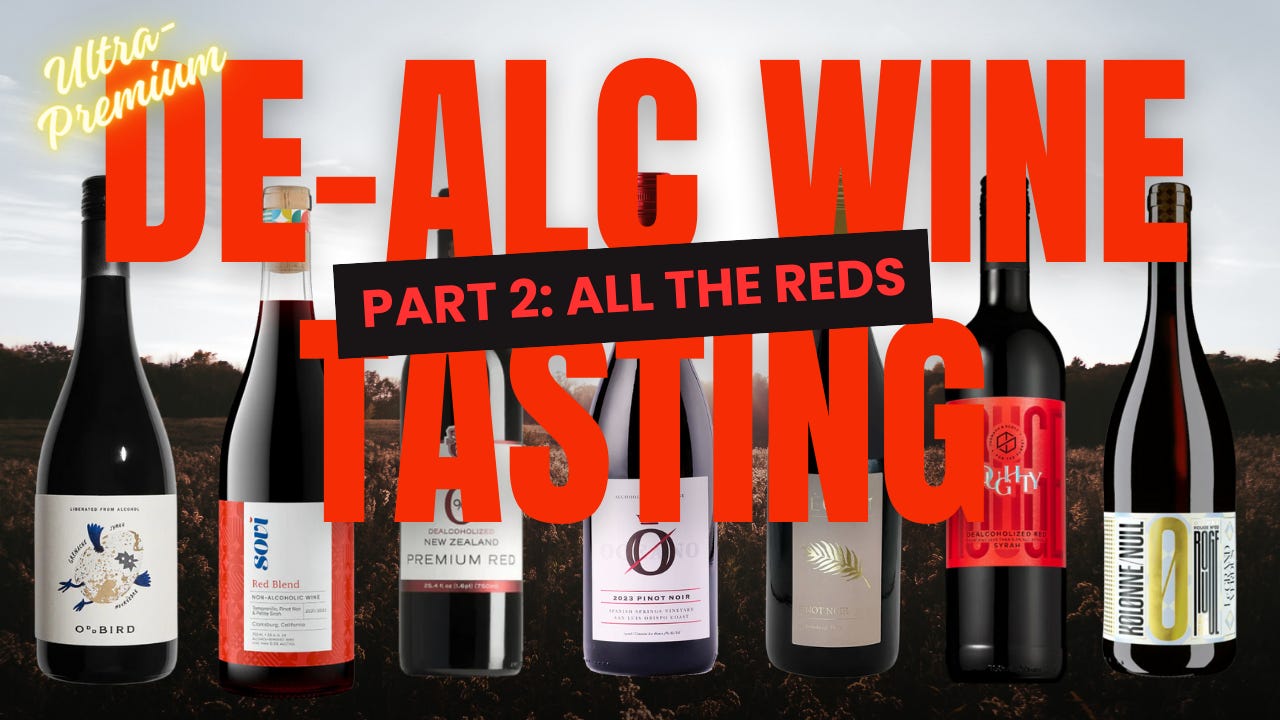
All The Reds
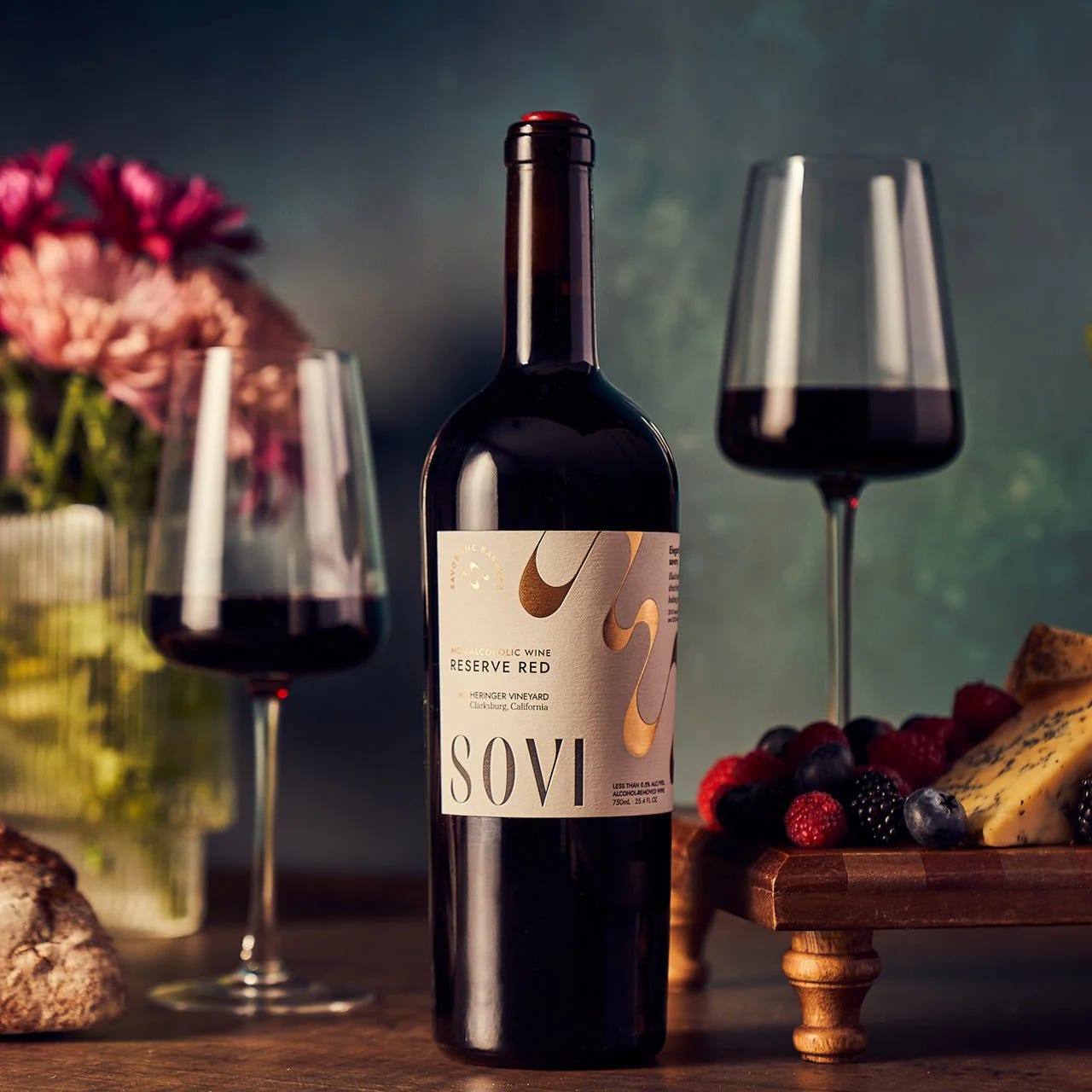
1) Sovi Reserve Red Blend, Clarksburg, California $42.00
Multi-Vintage blend of Tempranillo, Petite Sirah, and Merlot aged in a mix of American and French Oak.
Blend changes every bottling, but the style remains the same. Latest bottling (released after the one we tasted) is a blend of Cab Sauv and Merlot!1
Heringer Estates Vineyards. Clarksburg AVA, California
15 cal per serving, 75 cal per bottle
1g sugar per serving / 5g sugar per bottle
Dealc wine + grape juice concentrate.
Certified Sustainable.


From the winery: Most of our wines are bends of several different grape varieties for balanced structure, character, and aromas. We blend in a minimal amount of grape juice concentrate, like a dosage in Champagne. We do not add any additional sugar, sweeteners, or natural or artificial flavors.
TASTING NOTES: Made like a truly fine wine, very minimal sugar (in the form of grape juice) added. This wine lives and dies on how well the base juice was made, and we have to say: it was pretty damn tasty. Mostly fruity, sharp and tart black fruit flavors softened by the oak influence, which is well integrated and doesn’t overpower. Textures of the tannins allows for the lack of sugar without it feeling too insubstantial.
That said, you can quickly see from our scores below what the weak point was - “Complexity”. It was pleasantly fruity and a touch of oak but not much depth beyond that. Which almost doesn’t make sense: theoretically, the grape skins should add an abundence of additional aromas and flavors as compared to the whites we tasted last week, and yet we found this one too easy, too one note even when compared to many of said whites. And the body, while good, was noticeably thinner than is ideal. Flavors of blackberry and cedar and not much else. But Sovi is on to something here, and we hope future multi-vintage bottlings keep upping the ante.
DAVE: 12/20
Aroma/Taste - 3.5
Complexity - 2
Balance - 4
Body - 2.5
DALLAS: 10/20
Aroma/Taste - 3
Complexity - 1
Balance - 3
Body - 3
2) Kolonne Null Cuvee Rouge No. 2, La Meseta, Spain $25 - $35
Tempranillo and Syrah from the Central Plateau in the Castilla-La Mancha region.
19.2 cal per 5oz serving / 96 cal per bottle
3.6g added sugar per 5oz serving / 18g sugar per bottle
De-alc wine + grape must


From the winery: We rely on de-alcoholization by vacuum distillation in order to gently remove the alcohol from the selected wines down to a max residual alcohol content of 0.3%. The thermal vacuum has the advantage that the alcohol escapes at a low temperature of 30°C. This method allows us to keep the structure of the original wine intact while delicately separating the alcohol.
This is immediately followed by aroma recovery to capture the natural aromas from the wine. This preserves the diverse character and overall style of each individual wine. In order to hold higher standards we do not use any artificial flavors or coloring. We replace the sweetness that is diminished through the de-alcoholization process with a subtle amount of natural sugars.
Note From Dave: The shop I bought this at had an employee note in front of the bottle that said “What Javier Bardem would taste like if he were a wine.” Sold!
TASTING NOTES: This one had the complexity missing from the Sovi! Sssssspicy, a little sweet, excellent texture. The fruit had a hint of prickly pear on it, with dried red and black fruits akin to a fruit leather bar. Dallas was not as enamored by the flavor/aroma, but still gave this top marks for all other elements, including “Balance”! It should be noted, however, that after the tasting, this was the first bottle to turn sour (on Day 3.) So longevity post-opening is not its strong suit!
DAVE: 15.5/20
Aroma/Taste - 4
Complexity - 4
Balance - 3.5
Body - 4
DALLAS: 15/20
Aroma/Taste - 2
Complexity - 4
Balance - 4
Body - 5
3) Sechey Pinot Noir (Germany? California?) - $20
16.8 cal per 5oz serving, 84 cal per bottle
3.92g sugars per 5oz serving, 2.8g added sugar / 19.6g sugars per bottle
“Product of Germany”. But do the grapes come from there? Or is this just where the de-alc process occurs?


From the winery: This Pinot Noir is a sophisticated red blend, and excellent well-balanced choice to enjoy with dinner, or on it’s own. In this well-balanced red, you’ll find notes of ripened dark red fruits balanced with a note of the earthen richness of dried currants. Sèchey Pinot Nair includes a sought-after tannin structure, and a con1plex long finish, allowing it to pair equally well with a hearty steak or with grilled fish and vegetables.
Developed in partnership with one of the world’s leading wineries specializing in the dealcoholization process, Sèchey is proud to bring their line of non-alcoholic wine exclusively to Target shelves.
Note From Dave: Germany is the primary country where vacuum distillation occurs. Wineries from around the world undergo the de-alc process there, so when the bottle claims it’s a “Product of Germany”, I’m uncertain if that means the grapes are originally from there. Some postings of this wine claim it’s Pinot from California. But Pinot is also a staple in Germany (they call it “Spatburgunder”.) Unfortunately, we could not dig up clarity on this topic.
It should also be noted: while this wine is “exclusive to Target shelves”, we got ours direct from the Sechey website, which sells a wide range of other de-alc wines, too! It was a (nearly) one-stop shop for us.
TASTING NOTES: Really, really, really smooth. But still containing some depth. Lovely tart cranberry / pomegranate notes, noticeable minerality and acidity, lightly tannic mouthfeel, lightly sweet on the finish. Thoguh still runs afoul of being a bit too juicy and chuggable. There’s layers here, but post-tasting this was the wine you had to consciously pay attention to or you’d wind up quaffing it like iced tea.
This is also the only wine to delineate sugars in addition to “added sugars”, meaning some of the sugars were residual! It’s surprising this isn’t more of a thing in de-alc wine. I assume it’s due the lack of precision in leaving residual sugar behind vs. adding specific quantities.
DAVE: 13.5/20
Aroma/Taste - 3.5
Complexity - 3
Balance - 4
Body - 3
DALLAS: 14/20
Aroma/Taste - 4
Complexity - 3
Balance - 4
Body - 3
4) Noughty Rouge (Syrah), Darling, South Africa - $25
100% Syrah from Darling, South Africa
20 cal per 5oz serving, 100 cal per bottle
4g added sugars per 5oz serving / 20g sugars per bottle


From the winery: Produced with Syrah grapes from dryland farmed vineyards in Darling, South Africa. The grapes are grown in strategically selected sites, which get the warm sunny and cooling effect of the Atlantic Ocean. Deep soils from decomposed granite and rich clay help to provide good drainage.
TASTING NOTES: We were divided on this one. I was a fan while Dallas was not! The warm South African climate is strong in this one. There’s rich concentration of color and textures, and the elevated sugar levels deliver a body that was near perfect for me (and Dallas did agree the body was one of the best.) But this is a de-alc wine for those who can dig a “Parkerized” red. Not offensively so, at least I wouldn’t say, but it’s a big red. Dark fruit with that telltale de-alc wine tang,
DAVE: 14/20
Aroma/Taste - 3
Complexity - 3.5
Balance - 3
Body - 4.5
DALLAS: 9/20
Aroma/Taste - 1
Complexity - 2
Balance - 2
Body - 4
5) Giesen Premium Red, New Zealand - $15
Merlot? From New Zealand. “Blended to emulate New Zealand Merlot.” That’s all we know. Take from that phrase what you will.
94% Dealcoholized wine, 6% grape juice
29 cal per 5oz serving, 145 cal per bottle
4.4g sugars per 5oz serving / 22g sugars per bottle


From the winery: Easy-drinking, light-bodied non-alcoholic red wine from New Zealand. Blended to emulate a New Zealand Merlot without the alcohol. Expect delicate aromas of crushed blackberry and wild herbs in this alcohol-removed Premium Red Blend. Crushed red berries and plum offset by toasted oak on the palate. A light and refreshing option with classic structure and fine, powdery tannins on the finish.
TASTING NOTES: I was surprised to enjoy this a fair bit better than the Giesen Sauvignon Blanc we tried last week. You’d expect a company’s de-alc red to be worse than their white, but not here! Though Dallas was less enthused - a trend you may be noticing with these reds by now.
As with the Giesen sparkling and white, this was noticeably sweet, somewhat juice-like, but I found more to enjoy in terms of total flavors and depth. But acidity is not high, so what’s left is fruitiness and sweetness. Easy to sip, but likely most of us would tire of it quickly. It’s a one-glasser and then “what else ya got?”
DAVE: 10.5/20
Aroma/Taste - 2.5
Complexity - 2.5
Balance - 2.5
Body - 3
DALLAS: 7/20
Aroma/Taste - 2
Complexity - 1
Balance - 2
Body - 2
6) Surely Red, California - $27
Cabernet Sauvignon and Petite Sirah blend (75%), Pureh and Lapsang Suchong Tea, Natural Flavors (25%)
Whoops, this is the armoatised one!
30 cal per 5oz serving, 150 cal per bottle
5g sugars per 5oz serving / 30g sugars per bottle


From the winery: A complex, smoky, and layered NA red unlike any other. Dark fruit meets smooth vanilla, rich oak, smoke & spice. Not a varietal. A completely unique sip.
TASTING NOTES: Oopsie, this one is part tea, and a whole lot of botanicals tossed in, too! This wine literally includes cocoa, ginger root, French and American Oak extract, rosemary, two different types of tea, it’s a lot of a lot of a lot. But honestly? It’s pretty damn good.
As per usual, Dallas disagreed. Which is mildly ironic as he’s the one who’s usually attracted to herbal steeped beverages and I never am. (And that fact that he gave this wild concoction a “2” for “Complexity” makes me feel like he wasn’t being genuous on this one, or not open minded, something like that.) Regardless, aromatised wines are divisive, people have opinions about them, and this one won’t be any different.
But I found this to be a true alchemist’s blend. The wine is ripe and fruity, smooth, slightly tart, with the sharp zing of ginger and the tannic profile of the cocoa adding to that of the wine. The tea grants it an earthiness while also cutting the intensity of the fruit. Ngl, this isn’t as hard to pull off as pure de-alc wine, but I can see why you wouldn’t want to try. De-alc wine should deifnitely find its Amaros, Vermouths, and Byrrh’s.
DAVE: 16/20
Aroma/Taste - 4
Complexity - 4.5
Balance - 3.5
Body - 4
DALLAS: 7/20
Aroma/Taste - 2
Complexity - 2
Balance - 1
Body - 2
7) Oddbird GSM, Saint-Chinion, Languedoc, France - $27
Syrah, Grenache, Mourvedre, Carignan
28.8 cal per 5oz serving, 144 cal per bottle
5.76g sugars per 5oz serving / 28.8g sugars per bottle


From the winery: A silky, mature, and dry red wine from Saint-Chinian in the South of France. Made from Grenache, Syrah, Mourvèdre, and Carignan, it layers complexity, beginning with vibrant red and black fruits, a sharp tannic entrance, followed by deeper mature fruit and spices, and finishing with a pleasant, dry structure that showcases the wine's earthy and acidic qualities.
TASTING NOTES: We expected good things from Oddbird after they won the top spot in our Sparkling/White de-alc tasting. And their red does deliver, if not quite at the level of their Sparkling Rose or Still White. Bright tart red fruit, slightly salty and bitter, with a gently sweet finish to somewhat balance things out. Good mouthfeel, but not great. The ultimate experience feels overly light and smooth, with the tart elements outweighing the sweet. I found a touch more Complexity and less Balance whereas Dallas flipped those. It’s an interesting red de-alc wine no matter which side you land.
DAVE: 14/20
Aroma/Taste - 3
Complexity - 4
Balance - 3
Body - 4
DALLAS: 13/20
Aroma/Taste - 3
Complexity - 3
Balance - 4
Body - 3
8) 2023 Oceano Zero Pinot Noir, Spanish Springs Vineyard, San Louis Obispo, California - $55
100% Pinot Noir from Spanish Springs Vineyard.
5 cal per 5oz serving, 25 cal per bottle
1g sugars per 5oz serving / 5g sugars per bottle


From the winery: Oceano Zero features single-vineyard, single-vintage ultra-premium wines sourced from the sustainably-certified Spanish Springs Vineyard along the San Luis Obispo Coast.
All wines made from grapes from the Spanish Springs vineyard, vineyard is the closest to the Ocean in all of California. Ancient seabed soils nurtured by coastal fog cool ocean breezes. Ideally suited to produce elegant wines with purity of fruit, freshness, and depthAll wines made from grapes from the Spanish Springs vineyard, vineyard is the closest to the Ocean in all of California. Ancient seabed soils nurtured by coastal fog cool ocean breezes. Ideally suited to produce elegant wines with purity of fruit, freshness, and depth
Note from Dave: This is their second vintage, which consistently sells out before January the following year. Currently sold out though you can sign up for the waitlist.
Oceano started as a traditional wine brand, making full-alc Chardonnay and Pinot Noir, before expanding with their “Oceano Zero” label.
TASTING NOTES: The only other red de-alc wine besides the Sovi to use only 1g of sugar, but Oceano is even then 1/3rd the calories at only 25 calories for the whole bottle. Yowza.
And also: WOWZA. The only wine I gave a higher score to in this whole multi-part tasting was the Oddbird “Presence” White Blend, and Dallas matched his score on that one with this one. The lack of sugar does keep the body from scoring too high, but everything else here is nearly unbeatable so that’s not a complaint. Absolute harmony of flavors and aromas, softer than expected red fruit enhanced by flabors of herbs and minerality, the perfect level of acidity to match the sharper de-alc flavor profile, and no real sugar to speak of in need of counter balancing.
If there’s one fully de-alc red wine to try from this tasting, to see where the category is currently at, this is that one.
DAVE: 17.5/20
Aroma/Taste - 5
Complexity - 4
Balance - 5
Body - 3.5
DALLAS: 15/20
Aroma/Taste - 4
Complexity - 3
Balance - 4
Body - 4
9) BONUS 2023 Oceano Low-Alc (3.5%) Syrah, Spanish Springs Vineyard, San Louis Obispo, California - $60
100% Syrah from Spanish Springs Vineyard.
38 cal per 5oz serving, 190 cal per bottle
2g sugars per 5oz serving / 10g sugars per bottle


TASTING NOTES: Since we were going to place an order with Occeano anyway, I thought it’d be neat to try their one “Lo” (vs. “No”) alcohol wine to see how it compared to the fully “zero” alc reds.
And folks: 3.5% alcohol goes a long way. The difference was stunning.2
Almost no fully de-alc red wine could taste much like dark fruit - the lack of alcohol kept sharpening the flavors to tart and red. But here the fruit was properly black, properly traditional Syrah-like. The softness of the body, as well as the additional weight was apparent, and that tiny bit of alcohol balanced all the component pieces in ways the fully de-alc wines largely struggled to achieve.
Only the Oddbird “Presence” scored this high from me, and Dallas gave this his highest score of the whole tasting. Which generally point toward: if you can allow a tiny (but not insignificant) amount of alcohol be present, the leap in total enjoyment easily justifies it. I foresee the “medium strength” wines (6-8% alcohol) having an easier time taking off than the fully de-alc wines. Though, that said, humans suck as being actually “moderate” at walking a middle line. We’re all or nothing more often than not, so then again maybe not.
DAVE: 19/20
Aroma/Taste - 5
Complexity - 4
Balance - 5
Body - 5
DALLAS: 17/20
Aroma/Taste - 4
Complexity - 5
Balance - 4
Body - 4
10) BONUS 2021 Oceano Pinot Noir, Full-Alc, Spanish Springs Vineyard, San Louis Obispo, California - $45
100% Pinot Noir from Spanish Springs Vineyard.


No new surprises in tasting the full-alc Pinot after we tasted the de-alc version. Different vintage (2021 vs. 2023) but same vineyard for both wines, and this full-alc version is softer, fuller, more floral and aromatic (thanks to the alcohol evaporating and wafting all the scents up to us.) Gorgeous red fruit flavors with a kiss of oak and sweetness and not remotely too heavy. An excellent cooler climate Cali Pinot.
Summation
Averaging our scores together, the wines came out ranked in the following order:
2023 Oceano “Low Alc” (3.5%) Syrah ($60) = 18 Top Scoring wine of the whole multi-part tasting! That little bit of alcohol goes a long way!
2023 Oceano Zero Pinot Noir ($55) = 16.25 Top fully de-alc red!
Kolonne Null Cuvee Rouge No. 2, La Meseta, Spain ($25-$35) = 15.25 Good depth of flavor, not too sweet, best budget buy!
Sechey Pinot Noir ($20) = 13.75 The easiest drinking of the bunch while still retaining some complexity. This is whole bottle in one sitting wine.
Oddbird GSM, Saint-Chinion, Languedoc, France ($27) = 13.5 Very good, but not as balanced as their white! Gotta be in the mood for this one!
Noughty Rouge (Syrah), Darling, South Africa ($25) = 11.5 As long as you like a richer red! A bit polarizing!
Surely Red, California (aromatized!) ($27) = 11.5 One of us loved it, the other very much didn’t! VERY polarizing!
Sovi Reserve Red Blend, Clarksburg, California ($42) = 11 Solid, Smooth, but needs more!
Giesen Premium Red, New Zealand ($15) = 8.75 Enjoyable, but too much like juice!
The Reds were more divisive - it was rare for us to disagree signfiicantly with the sparkling wines, rose, or whites, but it occurred regularly while we sipped through the reds. This led to more middle-ish scores, fewer low scores when we averaged our takes together.
Similar to the whites, our top scorers were two different extremes: the least amount of sugar (Oceano Pinot) and also one of the greatest amounts (Kolonne Null.)
Even though our scores diverged between us, if we look at our individual scores alone, neither of us had as much range as with the sparkling and whites. Here, most of the reds stuck to a narrow window of 3-4 points. Meaning there wasn’t as much fluctuation in terms of percieved quality overall.
That low alcohol red! 3.5% alcohol made such a massive difference! Technically it’s 7x the alcohol of the fully de-alcs!
And that’s it for Part 2 and the reds. Join us TOMORROW for a special Coda / PART 3, where we take a look at a recent experiment which suggests an absolutly wild possibility for vacuum distillation and how the technology might be applied to wine of any alcohol level.
After prepping this post, I stumbled across the latest bottling at my local wine shop, so nabbed it to give it a try. And Sovi doesn’t lie: the blend changes but the style remains exactly the same! All our notes and scores still pertain to the latest bottling of Cab Sauv and Merlot. Decent stuff, but I hope they push themselves a bit more in the future. Maybe make a second style of red if this current red is too popular to futz with.
This probably shouldn’t have been surprising. The difference between a 12% ABV and 15.5% ABV wine is (perhaps) equally as stunning. But get on outta here with that logical crap!
The Surely Red had 30g of sugar in a 750ml bottle, so that is 40 g/L to standardize the measurement.
For comparison purposes, I looked up how many grams per liter (g/L) of sugar a few other beverages:
Lipton Sweet tea 48 g/L
Gatorade Classic 60 g/L
Arizona Sweet tea 86 g/L
Coke 108 g/L
There are some grocery store beverage alcohol brands with 20+ g/L of sugar and alcohol over 14%. It's not too hard to figure out those either, thanks to our friends in Canada who require imported alcohol to be tested in a lab for sugar content.
I'm still fascinated with the tasting and flavor analysis. Great work. I'm sure I'll get my hands on some.
Such a great roundup! I highly recommend Tomorrow Cellars’ red blend. It’s exquisite.