


Dallas asked me this question last week. And it only took me a moment to answer: Pulse.
Released in 2001 in a post-Y2K, pre-social media environment, Pulse was Kiyoski Kurosawa’s (Cure, Before We Vanish) poetical musing in regards to what this thing called the internet might do to society.
What’s thhe creepiest movie you’ve ever seen?
In Pulse, we enter a world where people are slipping away thanks to the pull of technology, fading into ghosts and leaving the physical world behind them. When transitioning into a ghost, they “stain” the spot they were last physically present, creating a “forbidden room” which can be sealed off. But if any still-living person enters such a room, the ghost will pull them into their depression, their despondancy, until that person also fades into a stain-ghost.
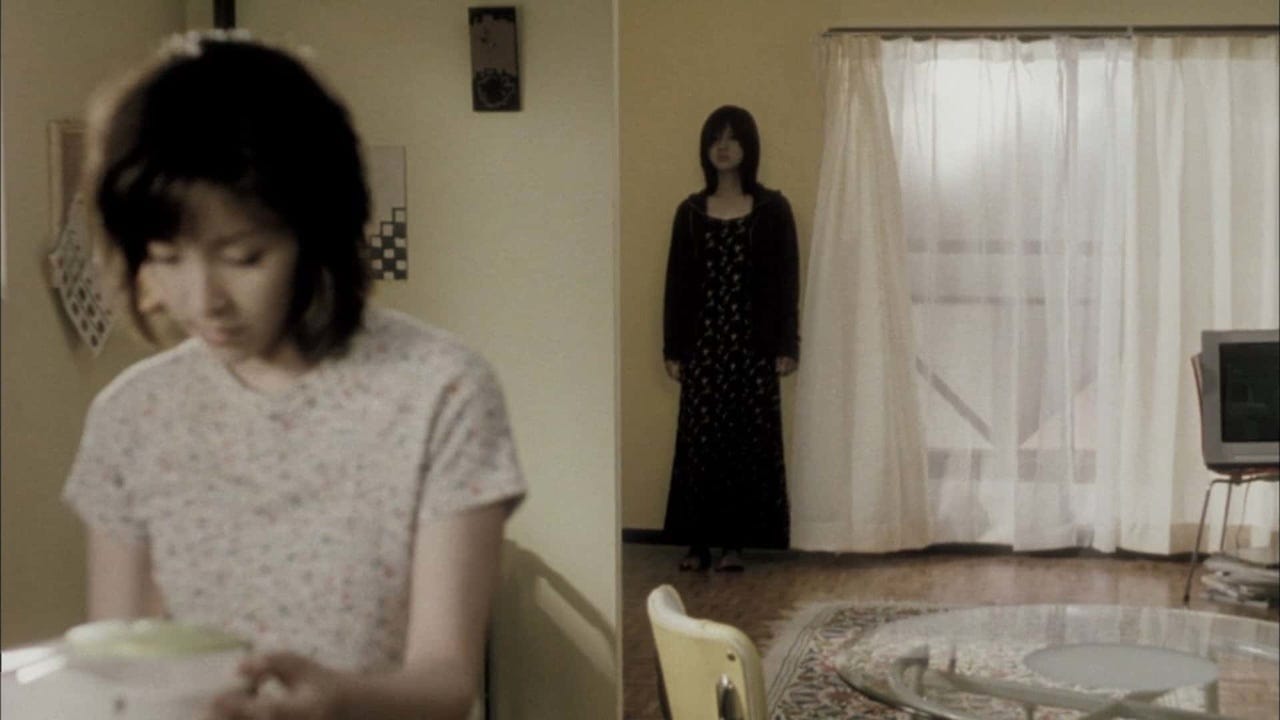
“The ghosts want to trap us in our own loneliness rather than kill us.”

In many cases, a person turns into a smoky stain-ghost while physically with another person. The other person might be making small talk, cheerfully proclaiming how they’ll stay together and not be lonely while only half-paying attention to the social interaction.
Meaning: physical presense alone isn’t enough. Interactions and interventions can’t alter the trajectory. Loneliness can be - and often is - other people as well.
Life rumbles on. Many strive to save their friends and family while simply being too busy and distracted to accomplish anything of note. And the ghosts continue to spread. Tokyo is soon an empty shell of taped up “forbidden rooms”, and we realize we are witnessing an apocalypse. The old world that we took for granted is literally dead and gone.
As Slant Magazine wrote in 2025, selecting PULSE as the #1 horror movie of the 21st Century: “Does this even count as metaphor anymore?”
Pulse has zero jump scares. Zero blood. Nothing happens quickly, and the most memorable scene of the movie - the scene, as most refer to it - is literally the slowest moving of the entire film. But it is utterly unnerving and, in my estimation, the creepiest thing I’ve ever seen.
If you’ve never seen Pulse - and make sure to watch the original Japanese movie and not the American remake, which largely mistranslates the concept - sit down on a nice quiet evening. Get into a contemplative, brooding mood. Then pour yourself one of the two wines below, and sink your teeth into both.
Just not so deep you fade into a stain on the couch.


THE WINES
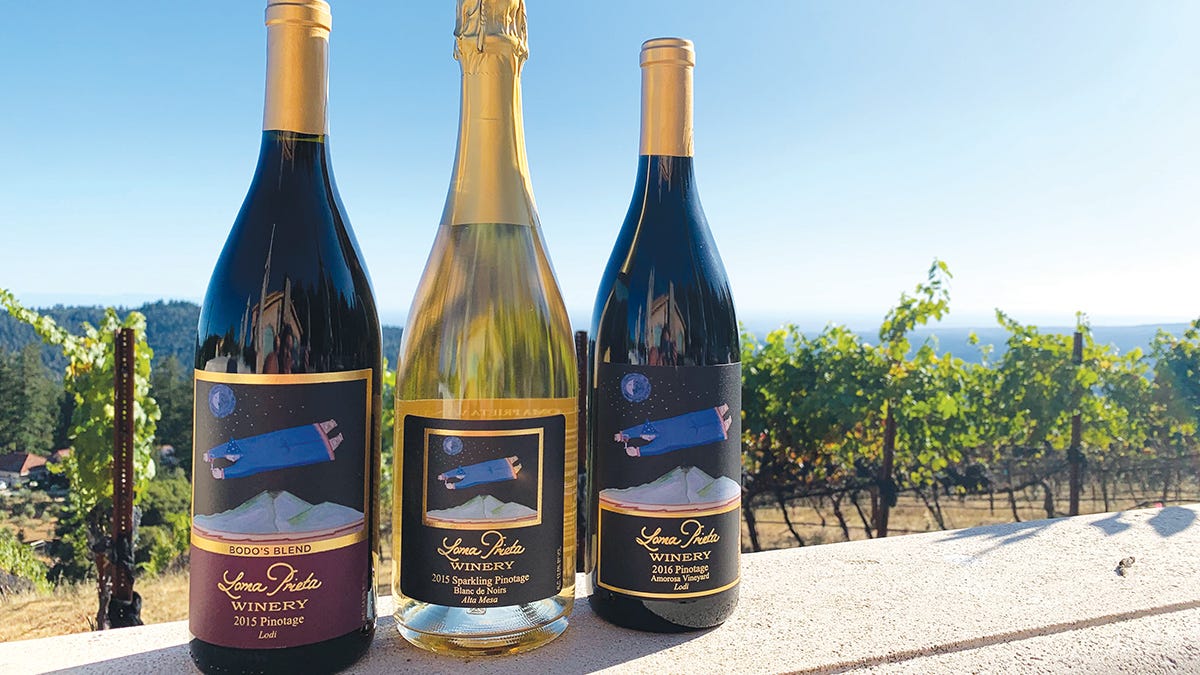
DAVE: Pulse is a movie about human loneliess. It’s dark, shadowy, literally smoky as people fade into smoke-like stains. So I wanted a wine from a lonely place: high up on a mountain. And a wine that I conisdered an “alone” wine, a wine I drink mostly by myself. One that, even when amongst other people, I often find myself nursing solo.
Loma Prieta is a winery founded in the Santa Cruz Mountains, by Paul Kemp (a personal injury lawyer) and his wife Amy Wiler Kemp (an attorney.) The couple fantasized about Mountain Living. They originally planted Chardonnay, Merlot, and Cabernet Sauvignon, but these struggled in the high altitude site facing the cool breezes from the Pacific Ocean. So they then grafted the vineyard to Pinot Noir, after which it began producing award-winning, Gold Medal wines, under the expert guidance of viticulture consultant Prudy Foxx, who is still involved with the vineyard today.
But then came a revelation. Paul discovered another grape. Related to Pinot Noir, that changed everything. A much bolder, darker, smokier grape...
Paul discovered Pinotage, a rare cross between Pinot Noir and a red Rhone grape called Hermitage (aka Cinsault). While it’s the most widely planted red in South Africa, less than 60 acres exist in all of California. He learned of the variety from his first winemaker, Paul Wofford, who was sourcing Viognier, Roussanne and Chardonnay from the Amorosa vineyard in Lodi, a vineuyard that also grew Pinotage.
“Everything about this grape, from its bodacious bouquet to its rush of fruit, carrying oodles of flavor to every part of your mouth, without any of the tannic bite of typical big reds, appealed.” —Paul Kemp
Paul was never one to do things cautiously, so once he fell in love with this variety he set out to find every vineyard in the state that grew Pinotage, eventually making four vineyard designates of the grape, including the preeminent version from the estate. Out went the Pinot Noir and in went Pinotage in 2013, where 3.5 acres of the highest altitude Pinotage in North America continue to thrive.
And now Loma Prieta is the largest producer of Pinotage in all of North America!
The label is a story in itself. Paul and Amy were big fans of New Orleans artist, Martin La Borde, whose work they collected on each visit to the Big Easy. They contacted La Borde and had him capture the view of Mt. Loma Prieta as seen from winery site to grace their wines. The yellow, red, and orange lines running beneath the green mountains represent the famous 1989 Loma Prieta earthquake. The flying wine connoisseur is a recurring character in Martin LaBorde’s work, a little magician named Bodo. (And the winery also produces a “Bodo’s Blend”, 80% Pnotage 20% Petite Sirah.) He’s flying over the mountain with a glass of Pinot Noir in hand, a peace offering to the gods that rumble deep within. Unlike in the movie, so far this has worked for Loma Prieta.
After her husband passed away in 2018, Amy became a “wine widow,” and ran the show pretty much single-handedly until November of this year. With both her sons now in college, it was time to move down from the mountain. Sinco 2020, Loma Prieta is now in the care of Chris Arriaga, a real estate entrepreneur and former US Marshall. He and his daughter, Samantha, both residents of Saratoga, will continue to operate the winery under its existing name, retaining all staff, along with longtime consulting winemaker Michael Sones.
I have a number of Loma Prieto Pinotage wines, because I love the grape so much, even though so few others do. They have an Estate Pinotage, two single-vineyard Pinotages, a “Bodo’s Blend” which is 80% Pinotage 20% Petite Sirah, an entry level Pinotage, and a Sparkling Blanc de Noir pure Pinotage!
I sipped the single vineyard - Amorosa Vineyard 2016 Pinotage. Because it was SMOKY. The Bodo’s Blend is smoother, fruitier, but Amarosa Pinotage displayed the smokey or “burnt rubber” or “campfire” quality that Pinotage is often infamous for, and which paired best with the flavor of the film.
I’m usually the only person craving Pinotage. It’s a deep, dark, brooding wine that I drink alone, but one which makes me happy.
“I have finally found happiness, being alone with my last friend in the world.” —Michi, at the end of Pulse (2001)


DALLAS: My approach to the pairing is more practical this time. It began with a simple question. If I found myself in the situation in act three of this film and I needed to make my way to the coast for a ship and uncertain safety then which wine would I take?
Because I would certainly need wine. And that wine would need to be 1)nearby 2) plentiful enough 3) easy to steal, pilfer a large quantity of.
And Gamblers Ghost CABERNET SAUVIGNON ticks all those boxes. How you ask?
Well,
I live near a Costco, so should the proverbial shit hit the fan then I “could” be one of the first people inside Costco.
Fior di Sole is a family-owned and operated winery which owns the Gamblers Ghost label. Their wine portfolio spans more than 3.5 million cases and includes 9 million gallons of storage capacity. Fior di Sole makes more than 1 million cases of wine under brands it owns and an additional 1 million cases for other brands, including retailer specific varieties. And Gamblers Ghost or one of its label mates would likely be well in stock on Costco shelves due to these impressive production numbers.
And since, we’re talking about the apocalypse, then it stands to reason that I’d have to help the other marauding lunatics break into said Costco and clear its shelves once word got out that it was the end of civilization as we know it. And while everyone else is busy stealing five pound blocks of Velveeta and fist thick pork chops, I’d be skulking away with a pallet of wine across the parking lot and then into the back of the car.
The 2022 vintage of Gamblers Ghost Cab Sauv received a minimum 92 points on a few lists and certainly gives me a bang for my buck.
The Gambler’s Ghost is 80% Cabernet Sauvignon, 15% Merlot, and 5% Petit Verdot, making it a Bordeaux Blend.
The grapes came from vineyards in the Lake County AVA (North of Napa) and Sonoma (west of Napa). The North Coast AVA is Napa, Sonoma, Mendocino, Lake County, and a couple of small AVAs.
It was aged for 10 months in 60% new French oak barrels.
ABV is 14.5%.
It’s black cherry in color. A berry, spice nose.
And you even get a little licorice in the taste.
And again, this wine could be found at Costco for under 10 dollars. But by the time this episode drops I may have already (clears throat) purchased all the bottles and made my way for the coast line. So, hopefully I’ll see you on the rescue ship. But just know, I won’t be sharing my Gambler’s Ghost.


