

Sentimental Value is the 6th feature film by Joachim Trier and co-writer Eskil Vogt, and his second partnering with actress Renate Reinsve after The Worst Person in the World in 2021.
It was nominated for nine Oscars, but because they’re all a bunch of dirty foreigners it only won for Best International Feature Film. Though by doing so, it became the first Norwegian film to ever win the category.
Joachim Trier and regular co-writer Eskil Vogt hit the scene with Reprise in 2007, a film that took them 5 years to write. They followed with Oslo: August 31st in 2011, the second of what would become Trier’s “Oslo Trilogy”. Then his stab at a film with a Hollywood cast in Louder Than Bombs (2015), a stab at a horror movie with Thelma (2017) and then he concluded the Oslo trilogy with The Worst Person In the World in 2021. The Oslo Trilogy are all set in Oslo and features actor Anders Danielsen Lie in a leading role and tend to revolve around the theme of social exclusion. Trier’s THELMA is also set in Oslo with a similar core theme, but does not have Lie in the cast, and therefore is not considered a part.
Riding high off the conclusion of the Oslo trilogy, Trier found himself with a blank slate for what he tackled next.
When asked about the inspiration for Sentimental Value Trier stated:
“The trigger for the story was when my mother put my grandparents’ house up for sale. I realized all of the 20th century had happened in that house. My grandfather was a resistance fighter who was tortured and barely survived, then became a filmmaker, and even went to Cannes in 1960. I think filmmaking was his way of coping with that trauma. It got me and [co-screenwriter] Eskil Vogt thinking about broader things, like how the war affected my family. Does it take three generations to get rid of that?"
Poetically, the house that features in the film, was a house Trier had shot in before.
"It turned out to be the house where we shot Oslo, August 31st, 14 years prior. So, I knew it very well."
Trier had scouted dozens of houses before arriving at this one, which he recognized and realized he'd been before. He instantly saw how scenes from the script would be shot there. Likely, the familiarity, the memories spurred this, which are the very themes of the movie itself.
Regarding the title: Trier says:
“I grew up in the ’90s, I come from irony, but this time I wanted intimacy and tenderness. I’ve had two kids since the last movie, and I keep asking: What do I pass on to them, and what was passed on to me? That matters to me now. My line is: Tenderness is the new punk.”
Trier and Vogt knew they were on a knife’s-edge:
“We were opening the faucet a bit,” says Vogt. “It’s easy to manipulate emotions; it’s easy to make people cry. That’s not a measure of quality. The title Sentimental Value was our way of admitting it. These emotions have value only if they come from an honest place.”
The premise of the film is as follows:
“Sisters Nora (Renate Reinsve) and Agnes (Inga Ibsdotter Lilleaas) reunite with their estranged father, the charismatic Gustav (Stellan Skarsgård), a once-renowned director who offers stage actress Nora a role in what he hopes will be his comeback film. When Nora turns it down, she soon discovers he has given her part to an eager young Hollywood star (Elle Fanning). Suddenly, the two sisters must navigate their complicated relationship with their father — and deal with an American star dropped right into the middle of their complex family dynamics.”
This is, without a doubt, the best film Trier has directed to date. It’s an evolution and apotheosis of his themes, characters, and style. There are strong similarities to Olivier Assayas’ CLOUDS OF SILS MARIA (2014) which we sort-of covered in our batshit 2-Part Fake Movies Within Movies Paired with Fake Drinks Within Movies with the equally batshit Decarceration. A 2-Parter that Sentimental Value could now be included within!
Fake Movies Within Movies Paired With Fake Drinks Within Movies - Part 1

Podcasting and independent writing ain’t easy, folks. If you love what we do here, become a subscriber! Just being part of our community means the world to us, and helps this Substack gain traction.
Fake Movies Within Movies Paired With Fake Drinks Within Movies - Part 2

Podcasting and independent writing ain’t easy, folks. If you love what we do here, become a subscriber! Just being part of our community means the world to us, and helps this Substack gain traction.
Wine Trivia Question of the Week
The Wines
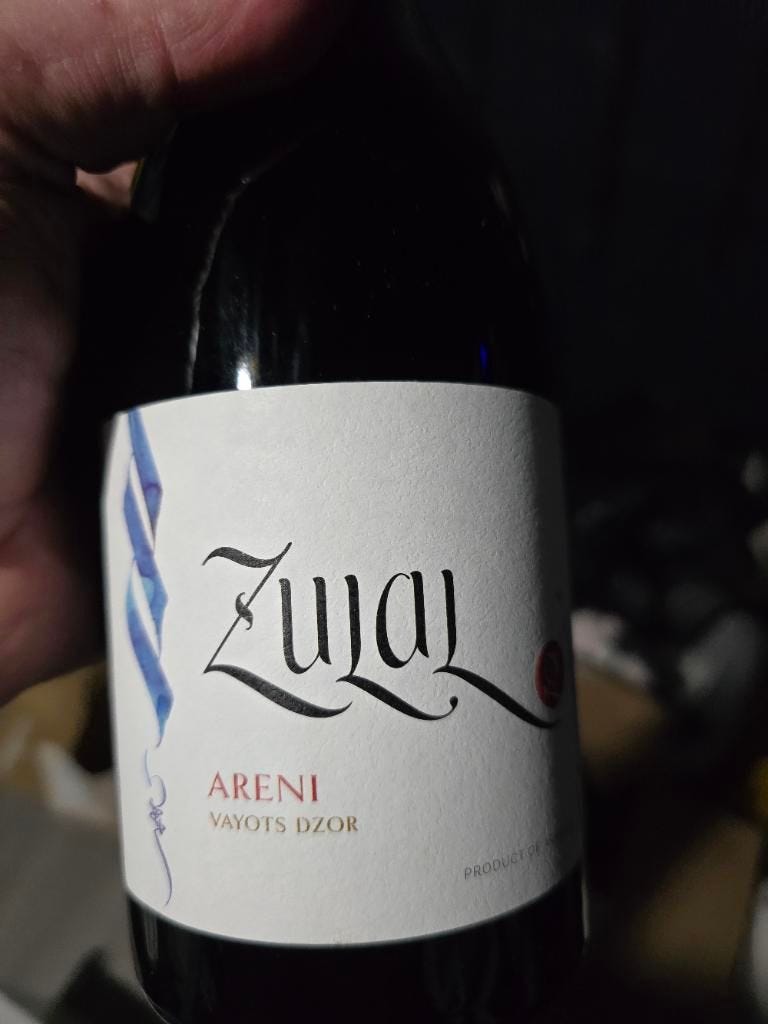
Zulal Areni, Vayots Dzor, Armenia
Dave Baxter: I wanted a wine with a father-daughter dynamic, though maybe one with a functional vs. dysfunctional one. (Hard to find a working winery if it was dysfunctional.) Also a wine that matched this movie’s emotional complexity but lack of gravitas, lack of elevated emotional quality. I needed to match it’s more grounded, everyday, quiet and gentle approach to peering into the depth of difficult interpersonal relationships.
Areni is Armenia’s flagship red grape. The Areni for this wine comes from small, family-owned vineyards in Vayots Dzor that are 50-70 years old. Situated between 1,400 and 1,500 meters above sea level and completely ungrafted. (So pre-Phylloxera1)
Areni is often compared to Pinot Noir, and it does share similar body, structure, and fundamental flavors - red fruit, herbaceousness, good acidity, noticeable but not hefty tannins. It’s complex, layered, it’s contemplative, but not harsh, and not difficult.
This winery, Zulal, was founded by Aimee Keushguerian, daughter to Vahe Keushguerian, the man who spearheaded the modern wine movement in Armenia. Aimee grew up in Tuscany surrounded by her family’s wine business, but went to study economic development and social entrepreneurship in college, as her interest was in bringing Armenia’s economy into the modern era.
Then her father, Vahe, invited her to work the harvest at his winery Keush in 2015.
“I never thought I would follow in my father’s footsteps, but when I came for harvest, I think a lot of things hit me at once. I’m a diasporan Armenian, so there is this broad notion of Armenians having this emotional draw toward rebuilding our nation post-Soviet Union. Secondly, was the potential and the opportunity to be a part of rebuilding a wine industry. And we’re rebuilding it. We’re not building it from scratch. We have a lot of ancient history, and we have history during the Soviet time, so being part of something that was being rebuilt, I think, was really exciting. It was a challenge.”
Aimee later founded Zulal Wines, dedicated to small-batch expressions of Armenia’s rare and indigenous grape varieties.
So a daughter who had no intention of following in her father’s footsteps, carvibg out her own space, while working to reestablish and reinvigorate her family’s traditions, roots, and culture for the modern moment. And a wine that contains multitudes without demanding anything from or forcing anythign onto its drinker.
P.S. Aimee is featured in A Cup of Salvation, the SOMM TV documentary longlisted for the Academy Awards, which follows her and her father’s efforts to make wine in both Armenia and the first wine from Iran in over 40 years.
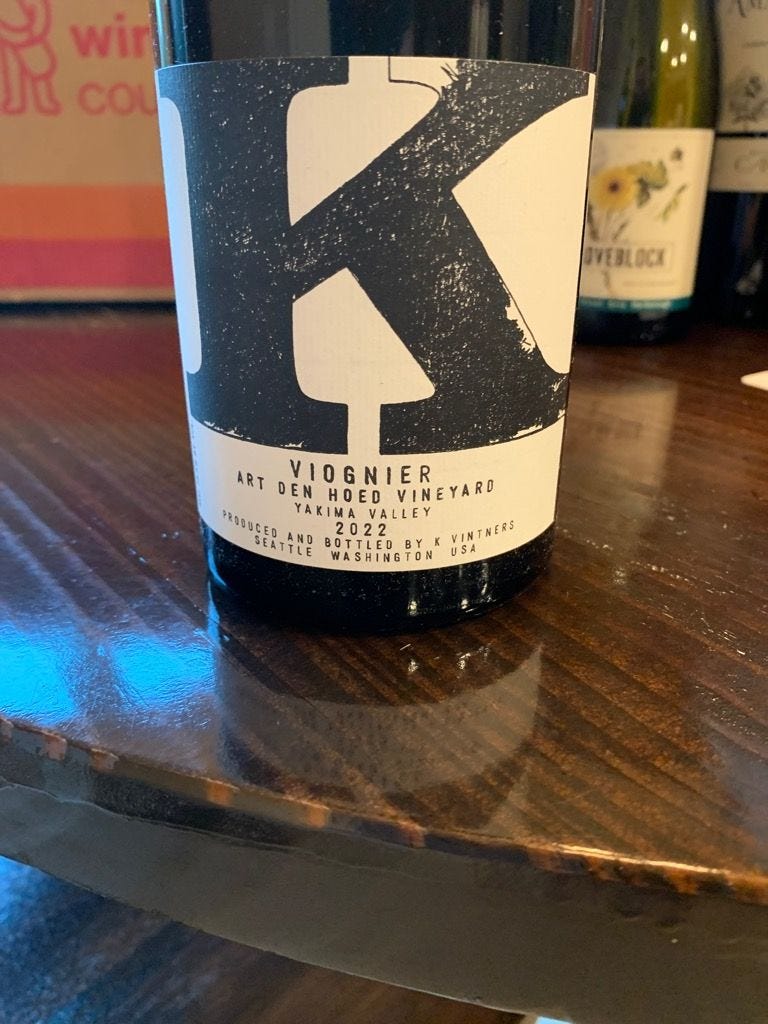
Dallas Miller: I wanted a wine that matched the watchability of this film, the ease of this film. But I also wanted it to contrast this film’s rather gloomy and austere style.
So it had to pull double duty. It had to be something that was a pleasant and easy drink. It also had to implore me to continue drinking and for the contrast, it had to be bright, sunny and colorful, in a way.
So I settled on the 2023 K Vintners Art Den Hoed Viognier.
It’s a lean and light to medium bodied wine that increases the salivary sensation or mouth watering. Like this film, every frame sort of makes you curious about the next. You want more. It’s sort of energetic and spritzy, like this film. There’s an exciting life behind the top layers.
It’s similar to the film, in that it is a very clean expression of some otherwise dirty and muddy components. It’s also similar in that the film is effortlessly watchable and this wine is effortlessly drinkable.
Note wise, you’re getting some honey suckle, maybe a little apple blossom, faint peach on the nose.
Drink it now. And also, watch this film now.
Located at the base of the Blue Mountains in Walla Walla Washington, K Vintners opened its doors to the public on December 3rd, 2001.
The site was originally homesteaded in 1853 with the adjacent farmhouse built in 1872. The winery grounds with Titus Creek flowing through the lawn and the old pioneer planted trees, is a little slice of heartland Americana.
The Winemaker: He loves to drink wine! Charles Smith, proprietor and winemaker, comes to Walla Walla after 11 years in Scandanavia. Originally from northern California, he has been involved with wine personally and professionally his whole life.
Phylloxera is a root louse that came from America and devastated the grape vines in Europe in the 1800’s. To this day, there is no cure for the pest - we’ve never discovered a way to kill it without also killing the vine. However, we did find a solution: American vine roots evolved to co-exist with Phylloxera, so we took them over to Europe, planted the roots, and then “grafted” the top part of the European vines into the American roots, and et voila! Roots resistant to the pest with grapes that were still ostensibly European. But some purists still say the unngrafted European vines are distinct in flavor and are prized. And some parts of Europe - usually those of high enough elevattion that Phylloxera has never made it to - still have such vines. Like these vines from Armenia.


