

SIDEWAYS was released October 22, 2004 by Fox Searchlight Pictures. It received widespread acclaim from critics and is now regarded as one of the greatest films of the 2000s. At the 77th Academy Awards, the film was nominated for Best Picture, Best Director, Best Supporting Actor (Thomas Haden Church), Best Supporting Actress (Virginia Madsen), and Best Adapted Screenplay, the last of which it won.
It’s mildly surprising that Paul Giamatti’s performance was not nominated as it is the primary thing most remember after seeing the movie. It was also the actor’s biggest breakout role, following his very first breakout performance in American Splendor.
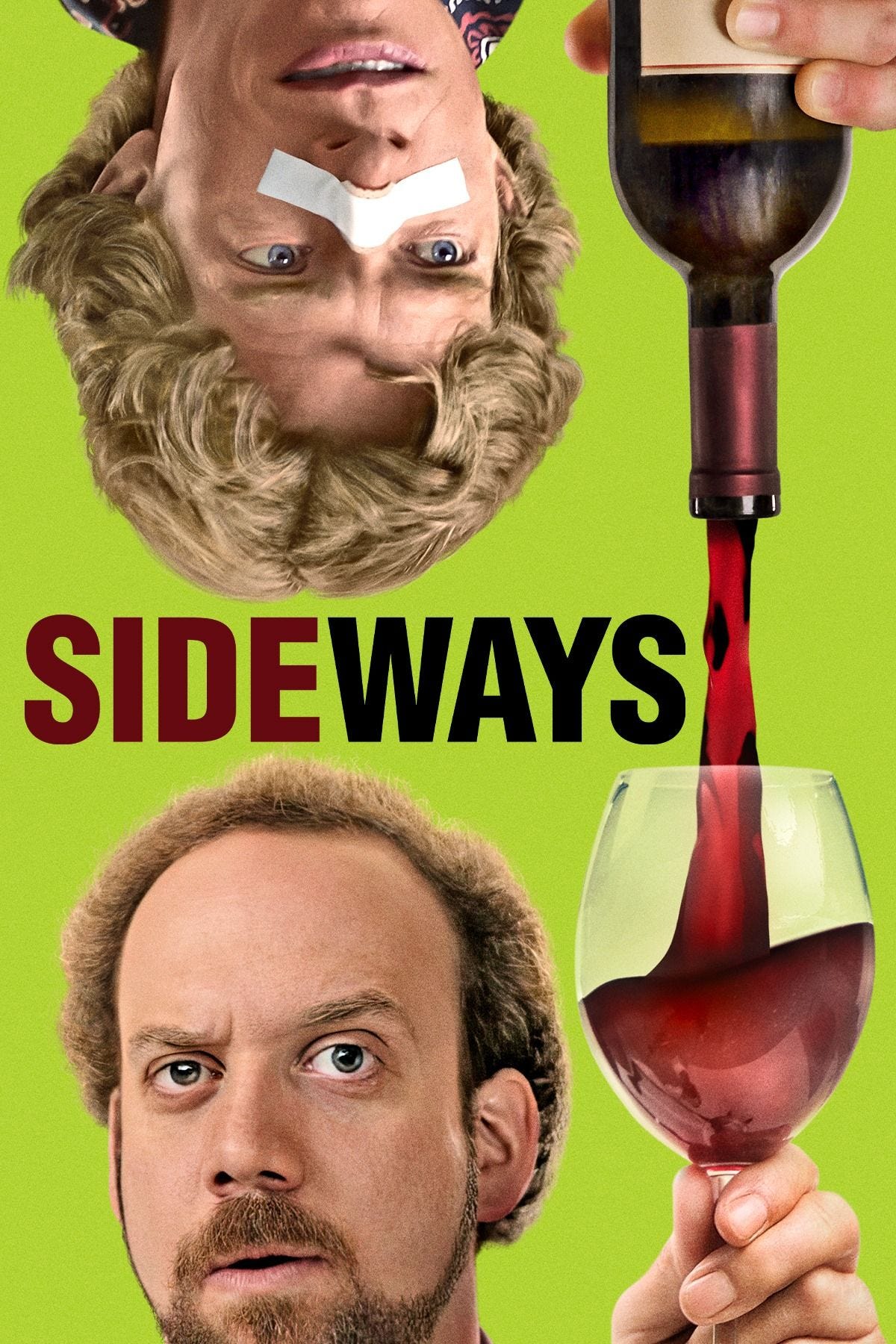
Case in point: Sideways’ most significant contribution to the culture was the shockwaves it sent through the wine industry as consumer behavior changed seemingly overnight thanks to one single exchange spoken by Paul Giamatti’s Miles:
With that melodramatic yet otherwise throwaway moment, American consumers started to abandon Merlot en masse. And Pinot Noir - the grape that Miles waxes poetic about in numerous monologues throughout the movie - became a superstar while Merlot sales plummeted.
This became known as “The Sideways Effect”. But, in truth, there was a previous, similar “Effect” from a popular broadcast that led to Merlot’s demise nearly 13 years earlier.
In November of 1991, 60 Minutes aired a feature called “The French Paradox.” It effectively asked, “if all the French consume are cheese, bread, and cigarettes, how are their hearts still beating?” The answer, investigators implied, was red wine.
The effect on the industry was immediate and extreme, and it served as a kind of rough draft for what would come later with Sideways. Across California, vinyards expanded rapidly, and many white varieties were replanted or grafted over to red, to appease public demand.
Madeline Triffon, the first female American Master Sommelier who had been working in wine since 1977 said “I was working the floor at the Rattlesnake Club [in Detroit] at the time, and it was like somebody hit a switch. Suddenly people that never drank wine would plop down and say, ‘No Martini tonight. We want red wine!” And she had to contend not only with an unexpected spike in wine sales, but a clientele that had no idea what they liked. “Most people’s concept of red wine was Cabernet. And they looked to me to give them a bottle that was like that, only softer.”
Merlot was the obvious fit.
The sudden demand for Merlot sent wineries scrambling for Merlot fruit/juice/wine—anything they could get their hands on. Plantings swelled accordingly. And the tendency to plant Merlot in less-than-ideal places - places that were growing white grapes, not red! - gained traction at both the macro (state) and the micro (vineyard) level.
In the end, the market was flooded with a lot of Merlot grown in the wrong places, and very rapidly people started turning away from it.
Meanwhile, in the wake of Sideways, Pinot plantings in California increased 170 percent. Which, to put that into perspective, plantings overall only increased 7-8 percent in that same time. This is especially ironic as Pinot is - as Miles states in the movie - even more finicky and difficult to grow than Merlot, meaning Pinot now in the same position Merlot was in 2004, with many bottom shelf and bulk bottlings of exceptionally poor quality Pinot abounding. And Pinot can rarely work as blends with other grapes, making its quality (or lack thereof) stand out even more than the easily blendable Merlot.
In retrospect, the “Sideways Effect” seems to have been the enormous surge in popularity for Pinot vs. the comparatively modest decline in Merlot sales. Because at the end of the day, the smoothness, fruitiness, and overall easy drinking quality of Merlot is what makes it stand out.
This entire saga is no better encapsulated than in the end of Sideways itself - when Miles drinks a legendary 1961 Château Cheval Blanc out of a styrofoam cup in a fast food diner. This is a priceless bottling of Merlot from Bordeaux, a wine Miles was saving to celebrate getting back together with his ex-wife (an event that was never likely to happen.)
His hatred of Merlot was due to her loving it, and his finally re-embracing it (Miles unquestionably knew it was Merlot) was him letting go of the past, moving forward into a new potential future. Just as we all should, perhaps, let go of TV talking heads and fictional narratives informing what we should drink and why.
We’re here to drink some Merlot, look side-eyed at Pinot, and talk about this legendary character-study dramedy-cum-wine-movie Sideways. Listen to the full episode above or on your podcast platform of choice.
The Wine Pairings
Dave’s Pairing
The main character, Miles, is unquestionably a Pinot Noir - he’s tempermental, difficult, layered, and expressive when coaxed but not a crowd pleaser in his own right. That could work well enough, but I don’t think this movie is a Pinot Noir. It’s easier, smoother, more assured of itself, more densely packed while also being very straight-forward.
This movie is closer to the two women in Miles’ life - Maya, his newfound love interest, and Victoria, Miles’ ex-wife. Both have a similar poise and assuredness. They are both divorcees but have reached a stage that Miles is desperate to achieve - centered on self-confiidence and self-love.
These two characters are what this movie is to me: it’s Merlot. It’s a grape that seems so easy - easy to drink, easy to grow, but it isn’t. It requires specific climates and practices to truly make great wine, just like any grape, just like any person in fact requires TLC and personal growth to reach maturity and self-confidence, but this film is about finding that. Finding your purpose, finding yourself in the current moment and what your future is meant to be. It’s about finding your center as a person.
And Merlot is the ultimate center of wine. It’s medium bodied, medium acidity, medium fruit landing between black and red, offering intense black cherry flavors, medium tannins so its slightly dusty but not too much. When allowed to ripen slowly, it will fully develop lush, rich flavors, retain acidity, and the tannins to counter the otherwise fruit-forwardness. Merlot needs clay-rich solid so the roots stay cool and retain moisture so the ripening is slow to retain acidity while also reaching full ripeness) in a climate that is neither too hot nor cold. With a little oak it will adopt cedar and spice notes that harmonize gorgeously with its textures and primary fruit flavors.
Merlot is the primary grape of right bank Bordeaux - Saint-Emillion and Pomerol being two of the best regions for it. And it grows beautifully in parts of Argentina, California, and Washington. I chose a Cali Merlot, in honor of the harm the movie Sideways causes to the Cali Merlot market in particular.
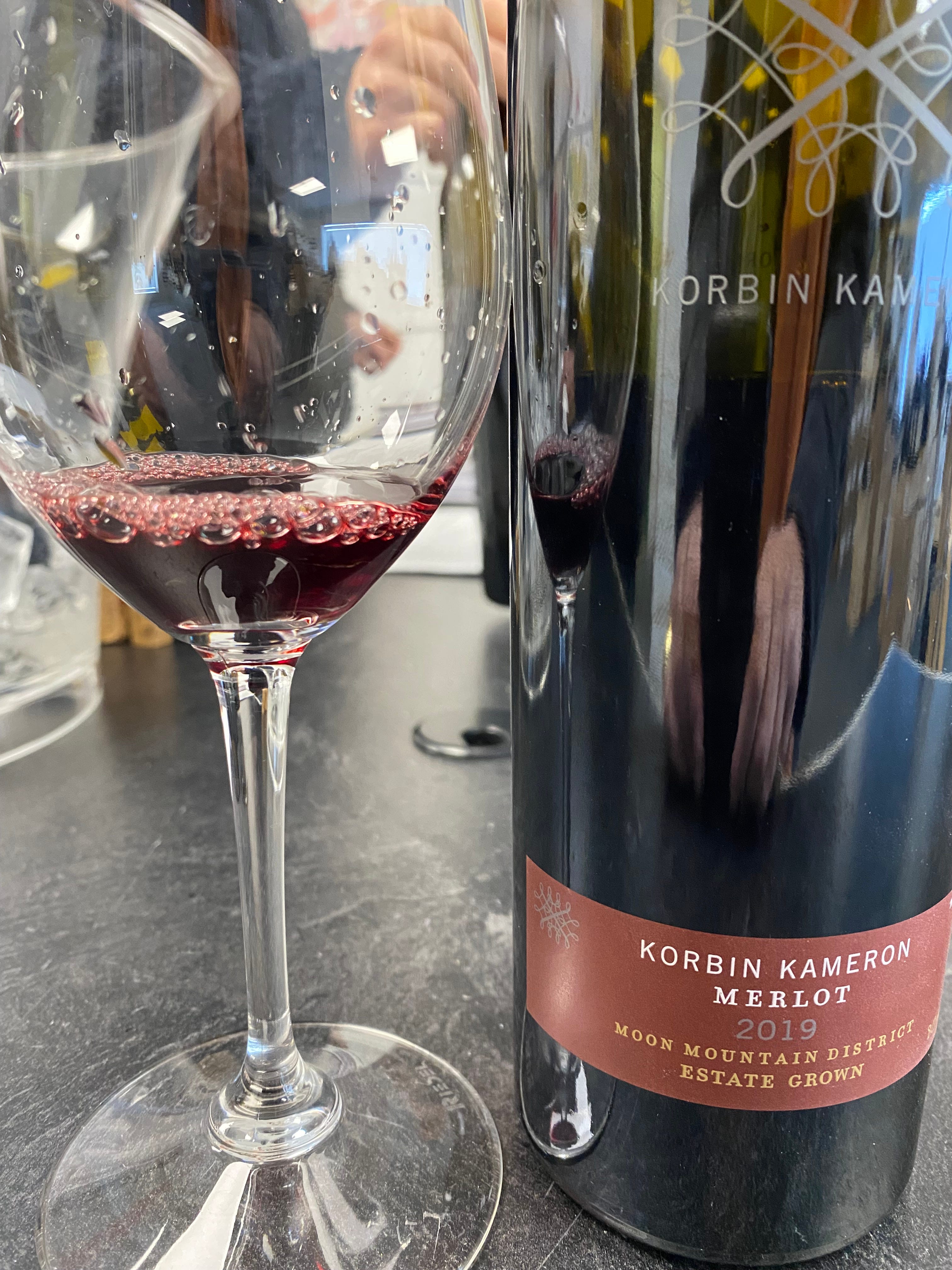
I chose Korbin Kameron 2021 Merlot from Moon Mountain District on the far east side of Sonoma County, Sonoma being the place where Pinot exploded in popularity following this movie’s release. The winery is run by the Ming family, of Chinese descent and named after their twins - son Korbin and daughter Kameron.
The wine is mid-price point, around $40-$50, I got mine for $42 from our sponsor Curated Wine Shop, and it’s deep, rich, velvety, with dusty but not overbearing tannins. The mediuum acidity offers lack cherry and sage and oak offers cedar on the nose and palate. Truly beautiful, a contemplative wine while not being challenging. A wine to sip and then savor for minutes, plural, to parse its many layers, yet it’s also just a lovely deep red. Let’s all remember how goood Merlot can be, even (or maybe especially) Cali Merlot.
Fun Fact: in the novel, at the very end when Miles is drinking his special wine he’d been saving for a reunion with his ex-wife, it was supposed to be an ’82 Chateau Latour, a left bank Bordeaux so Cabernet Sauvignon heavy, but Chateau Latour wouldn’t give the filmmakers the right to use their wine in the film. So Payne, who loves inside jokes and planting things in the frame that have to do with contradictions — especially as the movie is largely about lying, to oneself and to others — had Miles’s coveted bottle be a right bank Merlot heavy wine. The man who wouldn’t drink any fucking Merlot. It was totally intentional by Payne once he was forced to change the wine from Latour to something else.
Dallas’ Pairing
I took an alternate route into pairing this time. I paired with the character of Miles.
Miles is a storm of emotions and likely has a mind cloudy with confusion and regret and longing - all things that make living in the moment difficult.
He also seems rather acidic underneath. Perhaps this is due to Giammatti’s performance but the emotion being communicated behind his mask seems intense and possibly aggressive. This leads me to believe that if his life continued to get any more difficult, things could turn vary dark. (I even imagine a world of fan-fic where Miles is a secret serial killer in wine country on the weekends. Dave suggested the only way it would work is if Miles and Maya were both in on the serial killing. BTW…I may actually workshop this as a script and a spiritual sequel to Sideways.)
Anywho, I chose the 2021 Testamatta Bibi Graetz Toscana. Testamatta actually means “crazy-head” in Italian - and it describes the mind of our lead character to a T. He is tormenting himself with notions about merlot. He even has this hatred for the grape that once he excavates it is shown to just be due to his association with his ex wife.
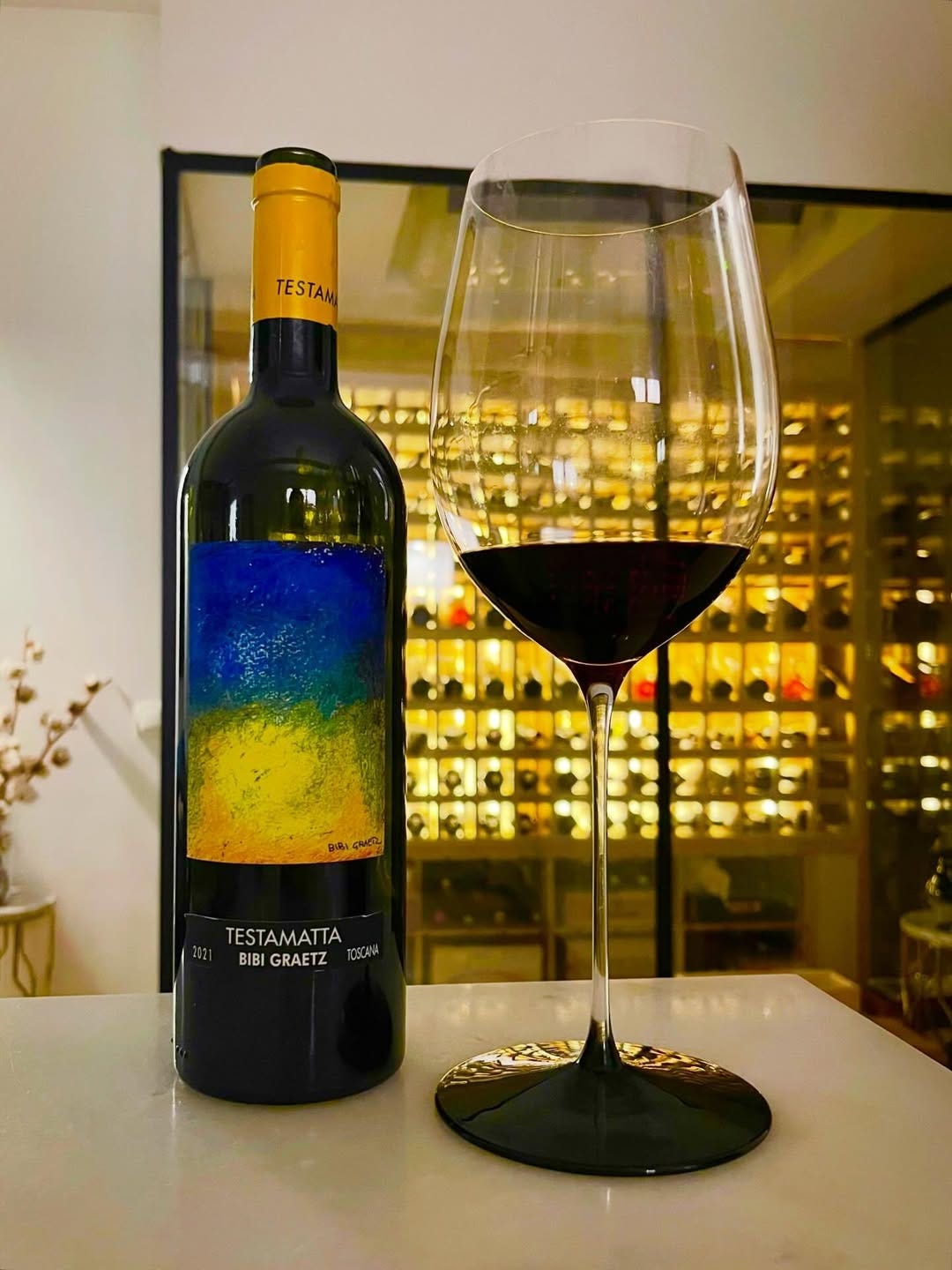
This wine is a Sangiovese from 35 to 50 year old vines on the top of hills with stony soils. A Toscana (Tuscan) made with 100% Sangiovese - which makes it a proper Tuscan and not a SuperTuscan, which has to have non-ingidenous grapes included like Cab Sauv, Cab Franc, and Merlot.
This one is pure Sangio, and it’s a bit of a jewel in that it is a lovely ruby color.
Aroma-wise I get hints of strawberries, orange zest and orange blossom. And everything is very clear, linear, there is no muddying. Very perfumed. Medium-bodied with noticeable tannins but fine in texture.
This wine is everything our character is: salty, crunchy, minerally and sometimes acidic. It can be found in a few places, but the best price - by a HUGE margin ($47 vs. $80 - $100+!!!) - is at COSTCO. If you’re not a member, it’s gonna be pricey.


