We had to cover it someday, so why not during the 50th Anniversary of the real life event the movie covers?
May 23rd, 2026 marked the 50th Anniversary of “The Judgment of Paris”, an event that changed the world of fine wine forever.
Throughout the 20th century, and seemingly even before, wine had been staunchly centered in Europe, and not just Europe but specifically France. Burgundy. Bordeaux. Cote du Rhone. Chablis. Sancerre. Provence. Sauternes. These are words - places - that to drinkers all over the world meant and still mean that the wine in the bottle is some of the finest they can find. It was on a level that almost no others could match.
Behind this thinking was the all important concept of Old World superiority which was and is rooted in the notion that fine wine required centuries of heritage and terroir specific to the “noble grape” of Europe. And these “noble grapes” were, originally, all French.
Wines of California and other “New World” wine growing regions were often scoffed at, dismissed as primitive and a poor man’s version of French wine. Even if - maybe especially if - they were growing and making wine with noble grapes meant for France’s terroir.
Yet by the 1970’s, word of mouth was getting around that the wines coming out of California and specifically Napa Valley were pretty g.d. good. British wine shop owner and educator Steven Spurrier was a convert. He thought the world needed to understand how good wines from outside of France and - god forbid - all of Europe had become. So he convinced a panel of all French judges to undergo a “blind tasting” - though he did spring the “blind” part on them at the 11th hour - of French vs. Californian wines. The best of both would be tasted side by side.
Shockingly, two California wines won the two top spots: Chateau Montelena’s Chardonnay, and Stag Leap’s Cabernet Sauvignon, beating out the Chard and Cab hailing from the finest wineries in Burgundy and Bordeaux, respectively. The French judges were so appalled, some tried to destroy their score cards before the news could get out of what they had done. But the news did get out.
BTW: My family actually founded and planted the original vineyards in Chateau Montelena! Waaaaaaay back in the 1800’s, the Tubbs family, which was my maternal grandmother’s fam. I had no idea about this until a few years ago - my people are in no way a “wine family” anymore, hardly any of them drink wine let alone make it. But hey! I’m kinda sorta not really wine royalty or what passes for it in New World California.
Happy St. Patty's Day! My Own Sort-of Irish Heritage in the World of Wine

Ireland is not exactly reknowned for its wine (though this may be changing with climate change!) or even for its love of wine (though they were in fact a big part of the historical development of Bordeaux alongside the Brits!) When we thing of Ireland, we think of Guiness and Whiskey and not much else. But the Irish have had a bigger hand in the wine wo…
What followed was an awakening for California wine - the rise of Napa and Sonoma Valley, and the sudden obsession with all things Chardonnay and Cabernet.
More than that, though, it also showed that other parts of the world could compete: France was no longer the unquestioned king of wine countries. With time, possibly any country, any terroir, could develop into a wine producing territory of equal quality. With or without “noble grapes”. Sometimes even with indigenous grapes that weren’t even of the same species as the noble grapes! It opened up the world, to the world.
That all said, many even in America - especially in America! - have argued that we need to stop talking about the Judgment of Paris. That we can’t keep clinging to this one story, this one event, to proclaim why people should be drinking Californian and American wines.
I am not exactly one of those people. It’s true that we can’t lean on it like a crutch. But it’s also true that the lesson it gave to the world needs to be relearned over and over again. The chokehold of Old World vs. New World is still pernicious. Even within the New or Old World themselves, the lesson needs to be learned as we debate whether there are any good American wines outside of, say, California, Oregon, and Washington; in the Old World, we’re still rediscovering wines and nearly-extinct indigenous grapes from Armenia, Greece, Slovenia, Slovakia, Portugal, and more. Ukrainian wine is now coming into its own!
“But it can’t be that good,” the world exclaims. And the lesson needs to be relearned, again and again.
And this story runs deeper than the Judgment of Paris itself. Believe it or not, this wasn’t the first time California wine beat French wine in an international competition. It was simply the latest.
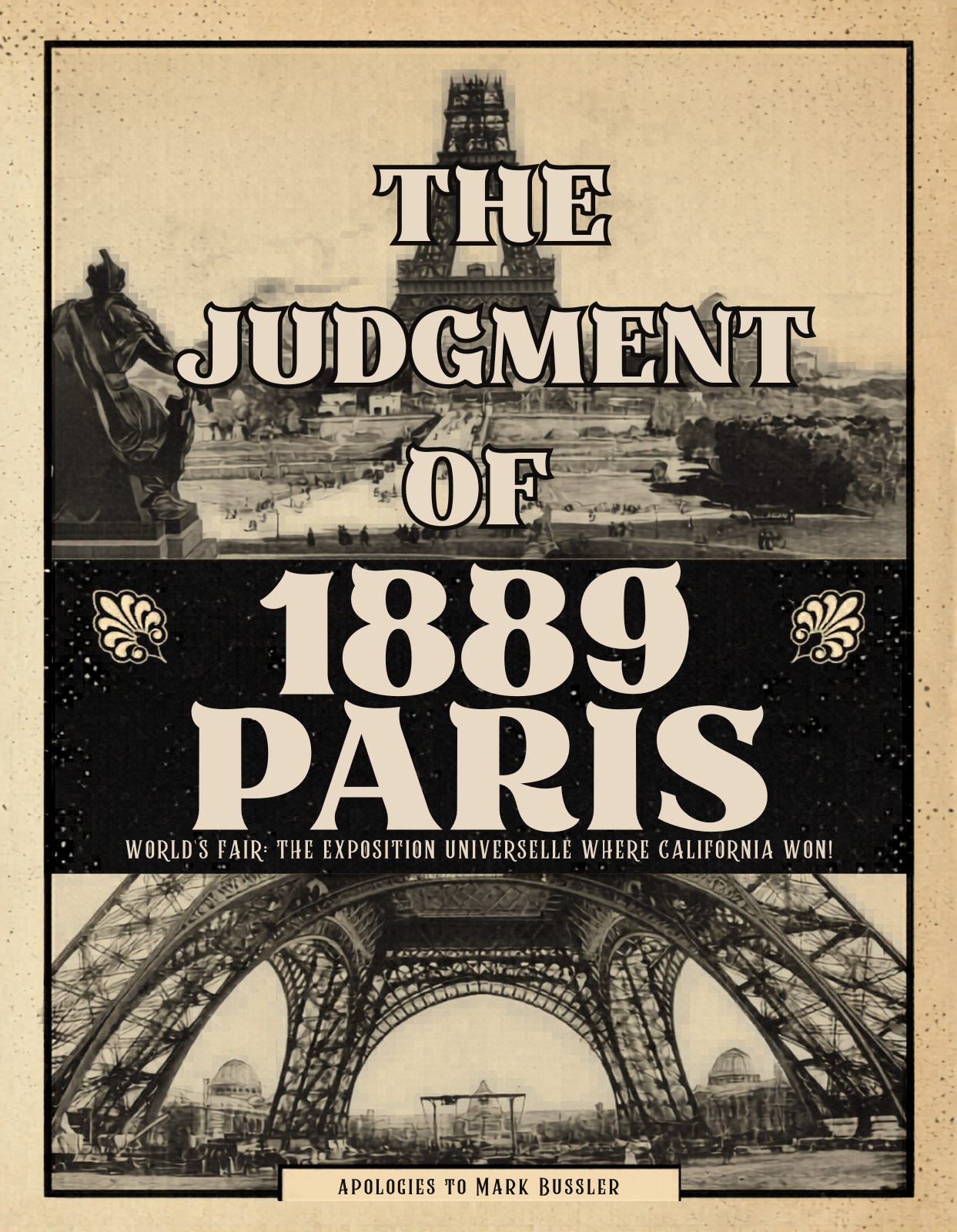
The full story of American wine’s history is too lengthy to include here in full, but the broad strokes are: American wine in the 1800’s won awards at multiple international competitions before finally clean-sweeping the 1889 World Fair - in PARIS - taking home 34 of 36 possible awards. It was, in all the ways that matter, The Judgement of Paris before The Judgment of Paris.
In the movie BOTTLE SHOCK, Alan Rickman’s Steven Spurrier quips “I don’t foresee the imminent cultivation of the Chicago vine.” Yet it was wine from Chicago! (Well, just outside Chicago.) And Los Angeles; from Livermore Valley in California; even wine from Missouri!!! That all took home awards throughout the 1800’s.
The French were so incensed then, that they changed the rules to invalidate Californian wines in the proceeding Word Fair competitions after 1889. And once we entered the early 1900’s, Prohibition essentially wiped out the American wine industry, which did not fully recover until the 1960’s - 1970’s, when the Judgment of Paris took place. And thanks to Prohibition resetting American culture the way it did, we largely forgot our history of award-winning, internationally competitive wines that existed nearly 150 years ago.
But for now, it’s time to dig into this movie BOTTLE SHOCK from 2008, starring Alan Rickan, Bill Pullman, Chris Pine, Chris Pine’s wig, Freddy Rodriguez, and Rachel Taylor. And pair some, perhaps, very Californian wines - or perhaps some very new-new world wines? This is a movie all about the new overtaking the old. So…Happy 50th Anniversary Judgment of Paris. As current Californians, we salute you.
Did You Know They Made BOTTLE SHOCK: THE MUSICAL?!? Well, They Did.
This sampling suggests it was…about as good as the movie. Make of that what you will.
THE WINES
DAVE’S PAIRING
I first saw Bottle Shock in the early 2010’s, before I’d fallen into wine. I knew nothing about the real life Judgment of Paris, I simply wanted to see an Alan Rickman / Bill Pullman film. I recall that I liked it quite a bit - similar to how you can be in the mood for a perfectly by-the-numbers Rom Com, this indie drama checked all the boxes for me that day. Did I learn a lot about wine and take to heart anything about the “Judgment of Paris” event? Nein. I watched the movie as though it were pure fiction, though I think I did clock, in passing, that it was “based on a true story”.
Revisiting it now, and even putting aside all my wine knowledge that I’ve accumulated since, the movie does not hold up well. Every actor is dialed to 11 at all times. The dialogue is cliche-riddled and the pacing somehow both too quick and plodding at the same time. We spend an inordinate amount of time in California on bullshit love triangles and made-up father/son meltdowns that never add up to much. The characters never unfold into a second or third dimension - they remain tightly one-note throughout. Alan Rickman being perfectly Alan Rickman can only assist so much.
So…I needed a wine that could be the antithesis of the film, a counter-pairing of complexity and delightfulness. Leaning into the real-life event of the Judgment of Paris, I considered a wine from the “New World”, a wine that the event opened up to the public going forward. At first I didn’t think I’d stick to California, but then I considered…what grapes did I think should have become the red and white grapes of California instead of Chardonnay and Cabernet Sauvignon?
I discuss this more at length in the podcast episode, but I soon settled on my pick for the red grape, a parent of Cab Sauv, and a grape that grows with much more elegance and consistent complexity in the state of Cali-for-nai-ay - Cabernet Franc.
Back in the 1970’s, it’s possible that Cab Franc struggled to get ripe enough in Cali, just like it did in Bordeaux. But today, Cab Franc seems far and away the superior fine wine grape. Now adopted by Chile and Argentina as well, it delivers the best of both “Worlds” - the richness of the New World with the complexity, the earth and spice and balancing astringency of the Old World.
Taking the thought even further, I considered how poorly the film was written, and wondered: what if the winemaker was a great writer, too?
Enter from stage left: Steven Kent Mirassou. The man who harbors a deep, borderline monogamous love with Cabernet Franc, and has worked hard to make it the future red grape of the Livermore Valley in California.
His Steven Kent Winery produces a number of Cab Franc bottles, but one of the more fascinating offerings is his Elements 4-Pack, with a bottle each of Cab Franc aged in STEEL, ROCK (concrete), and WOOD (oak), and a fourth ELEMENTS bottle that’s a blend of all three!
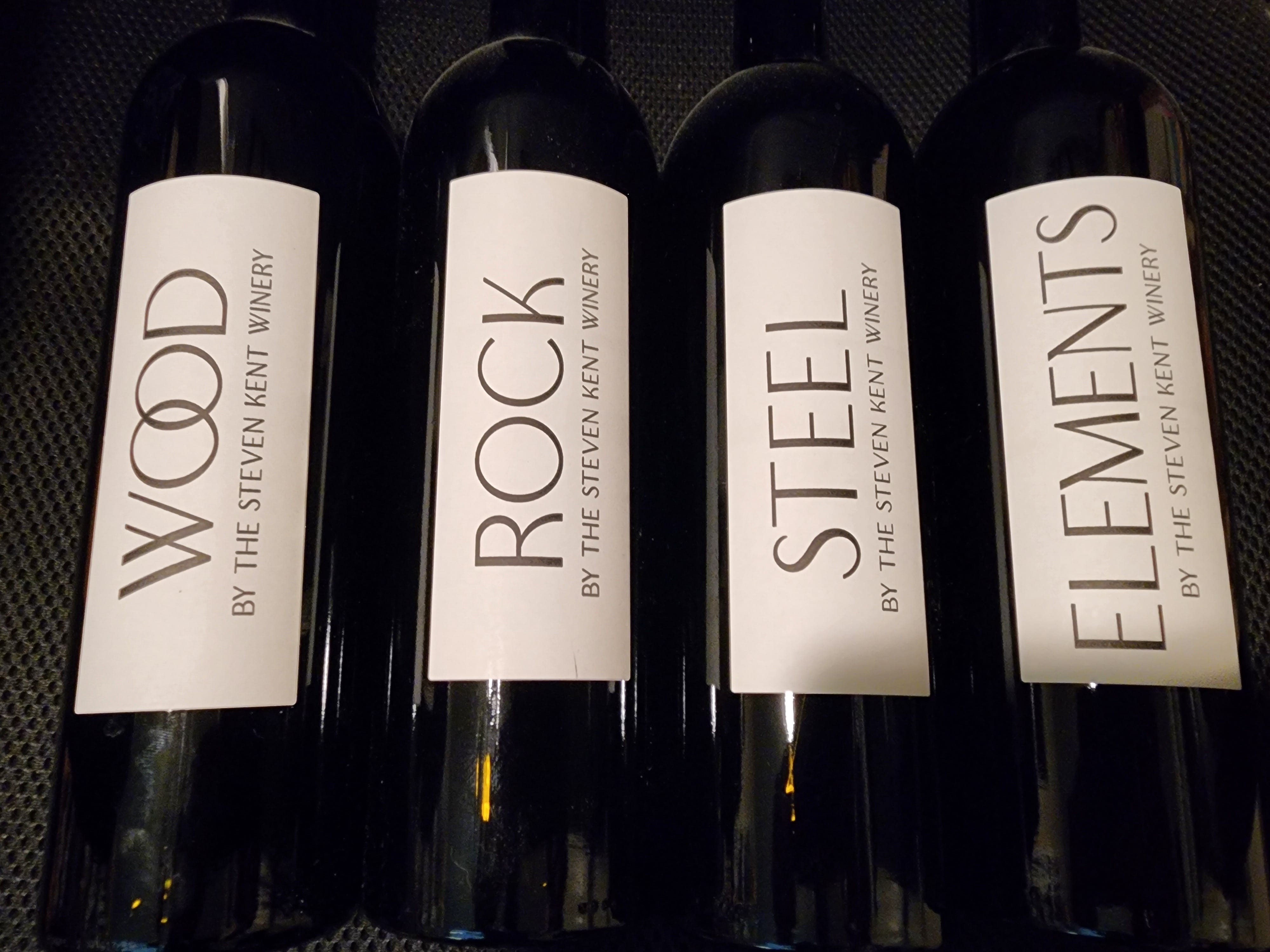
It’s a perfect way to experience the wide range of expressions that Cab Franc can give even within a single vintage. By aiming to make a Loire-style French Cab Franc but in the New World terroir of California, the wines are the best of both worlds. You get generous fruit (to match the movie) but also the missing complexity and depth, the preserved acidity for much needed lift. And by sampling all 4 while watching the movie, you’ll be kept enrapt by the wine and you won’t miss anything from the movie. Trust me: you could fall asleep for 10 minutes and not miss anything critical in the movie.
And don’t forget the “great writer” part: Steven is one of the best wordsmiths I’ve yet encountered in the world of wine. And that isn’t shade on any other wiine writer! It’s a high bar! But Steven is ouright novelistic in his ability to write a god damned sentence, my friends.
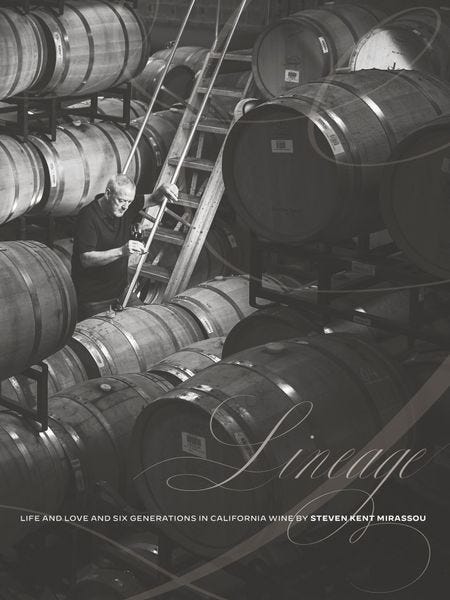
Over a year ago (because what is time?) Steven send me his book Lineage: Life and Love and Six Generations in California Wine. It’s essentially a Journal, looking back on his history and his present, waxing philosoophical about both, with thoughts toward the future. It’s deeply personal. Not remotely thrilling. It should bore me to tears, but the writing is so beautiful it sucks me right in.
I swear by this book. Literally. Every time I’m next to it and reading a passage I exclaim “f********ck!”
DALLAS’ PAIRING
Alan Rickman’s Steve Spurrier quips that in the coming years he suspects they will see chardonnays from all around the world. And right he was. The new world seemed to open up after this moment.
And as we mentioned in the episode, the film left me wanting to rewrite the hell out of it in order to find something more thrilling, I suppose. The Judgement of Paris stands as a marquis event in the history of wine and calls out for a grander take. It’s a summit of sorts, where old meets new. Where new proves its worth and old is reminded of its limitations.
So for my pairing, I wanted to go with something that combined the cache of the old world with the entrepreneurial spirit of the new world.
And the duo that willed this wine into existence represent both traditions in their work.
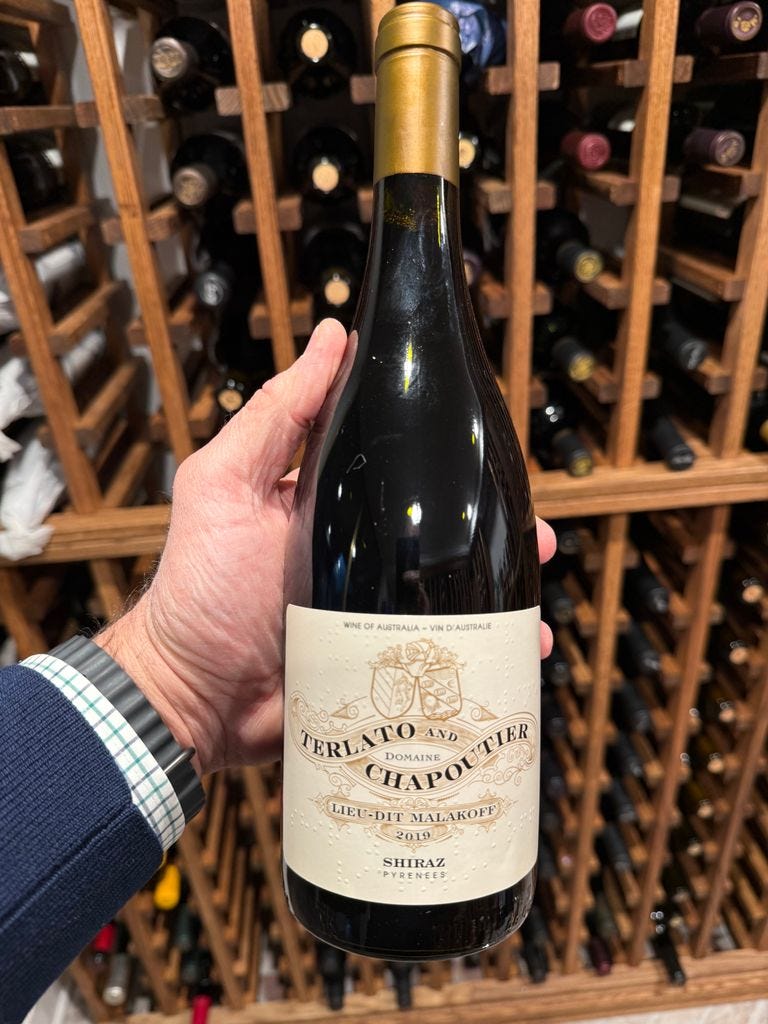
My pick is from Domaine Terlato & Chapoutier which is a collaboration between legendary French Australia wine grower, Michel Chapoutier and wine industry icon, Italian-American Anthony Terlato.
The 2019 TERLATO & CHAPOUTIER SHIRAZ
The Chapoutier family have been working in the Rhône Valley since 1808. Their ancestor, Polydor Chapoutier, was the first to buy vines there, shifting from being a simple grape grower to making and trading his own wine. And now that pioneering spirit is visible seven generations later with Michel Chapoutier.
Anthony “Tony” Terlato, chairman/founder of Terlato Wine Group who indelibly influenced the American wine industry and culture for over 60 years with his work with Pacific Wine Company, and Rutherford Hill.
According to the literature the soil is composed of schists, lauzes (rocks made of limestone and quartz).while their harvest is performed at maturity- usually 2 weeks later than neighbouring plots, avoiding over-maturation.
100% destemmed grapes are fermented in concrete tanks with maceration lasting from 4 to 6 weeks followed by a gentle extraction and a long maceration on skins to ensure elegant and fine tannins.
100% of the wine is aged for 18 months in French oak barrels.
It is an intense and deep ruby colour with hints of violet with black fruits, violet and liquorice on the nose. And a spicy, slightly acidic palate with wild strawberries.
And in an uncanny way I give homage to the old world in the grape and in the background of the two people- Terlato of Italian heritage rooted in America and Chapoutier who’s of french heritage rooted in Australia.